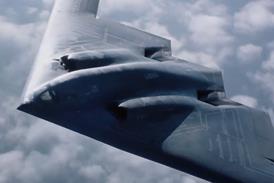













A damaged Northrop Grumman B-2 stealth bomber has returned to frontline duty with the US Air Force (USAF) more than four years after an accident sidelined it from service.
The Air Force Life Cycle Management Center (AFLCMC) on 3 December revealed that B-2 tail number 89-0129, named the Spirit of Georgia, has been restored to flight status after years of extensive work to repair damage suffered as a result of a landing gear failure in September 2021.
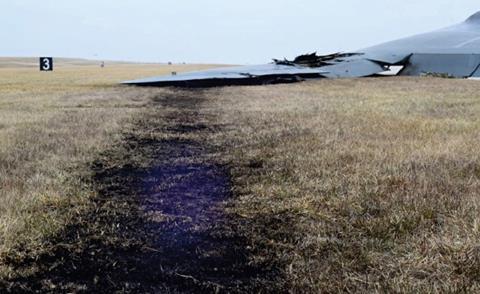
In that mishap, a hydraulic system failure forced the flight crew to execute an emergency extension of the landing gear. During landing, a critical mechanical lock designed to compensate for the lack of hydraulic pressure failed, causing the left-side landing gear to collapse.
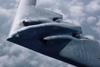
The left-side of the stealth bomber’s blended-wing body fuselage then scraped the runway surface, damaging both the wing structure and all-important radar absorbent coating.
“The road to recovery was long and complex,” the USAF notes.
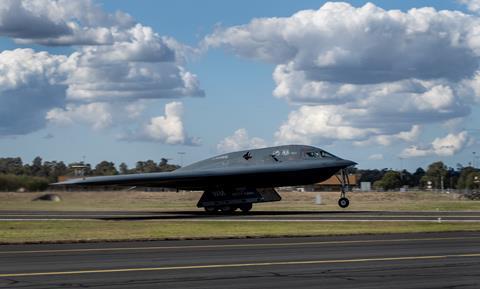
Immediately after the gear collapse, the incident B-2 was restored to partial working order through the use of inflatable air bags to lift the aircraft enough to engage the mechanical lock on the failed landing gear.
This allowed for basic repairs and a one-time ferry flight from the B-2 fleet’s home base of Whiteman AFB in Missouri to Northrop’s experimental aircraft development and assembly hub in Palmdale, California.
That site is the current home of Northrop’s B-21 programme, where the company is assembling low-rate production examples of the USAF’s next-generation stealth bomber and successor to the B-2.
At Palmdale, Northrop and AFLCMC personnel performed laser dimensional inspections on the incident B-2 and were able to determine that critical surfaces such as flight control attachment fittings and landing gear bay fittings had not been catastrophically damaged.
Separate evaluations found no damage to the outboard wing spars, but the aircraft’s wing surface did require substantial rehabilitation.
“Damage to the B-2 AV 89-0129 aircraft was extensive and required unique repairs, including reconstruction of the damaged left wing,” says Jerry McBrearty, B-2 programme manager for Northrop.
According to the air force, one of the most significant engineering challenges during the process was controlling heat distribution while repairing sections made with composite materials.
“The distribution of localised heat to the areas needing cure, while maintaining localised control as repair areas were in enclosed, confined spaces and directly adjacent to critical joints and structure was a huge challenge,” says Matt Powers, structure engineer with the USAF’s B-2 System Program Office.
“This was overcome by utilising advanced custom-built heating equipment, performing thermal surveys and adjusting insulation and cooling air throughout the final cure,” Powers adds.
Northrop’s McBrearty confirms that composite repair techniques not previously used on the B-2 were imported from some of the company’s other programmes.
One section of composite skin measuring roughly 2.54m x 1.2m (8ft x 4ft) was cannibalised from an existing B-2 test article and applied to the lower wing surface. This “significantly reduced” the cost and time of repairs when compared to fabricating a new composite skin, according to the air force.
The left-side wingtip, outboard wing major mate skin panel and the left-side main landing gear door hinges were all replaced.
Repairs on the incident B-2 were completed in May at a cost of just under $24 million and the aircraft has since returned to frontline duty, the air force says.
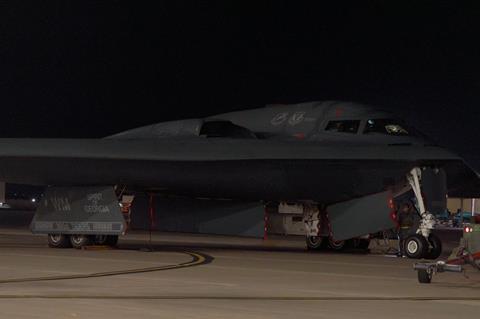
The return of a B-2 to flight status is a significant boost to the USAF’s combat capability.
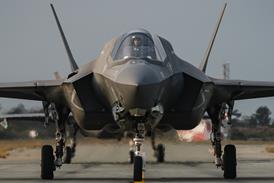
The flying-wing type is the Pentagon’s only low-observable heavy bomber capable of penetrating contested airspace and one of only two US stealth aircraft rated to carry nuclear weapons, with the other being the Lockheed Martin F-35A.
However, the enormous cost of the B-2 ($2.2 billion per example in 2024 values) led the USAF to only field a small fleet of 20 aircraft.
The B-2 was the Pentagon’s weapon of choice when the Trump Administration ordered a bunker-busting strike on Iranian nuclear enrichment facilities earlier this year.
That mission, known as Operation Midnight Hammer, sortied more than half the entire B-2 fleet, with seven bombers forming the core of the strike package that entered Iranian airspace on a non-stop, round-trip flight from Whiteman.
A similar number of B-2s were sent west over the Pacific in a feint meant to obscure the intended time and approach vector of the strike force.
The entire Midnight Hammer operation represented the largest-ever deployment of B-2s at one time.
The USAF hopes to address this critical bottleneck with the forthcoming B-21 stealth bomber by committing to fielding a much larger fleet of at least 100 aircraft.
B-21 flight testing is currently underway at Edwards AFB near Palmdale, with at least two flight-capable examples known to be in operation.