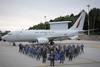
















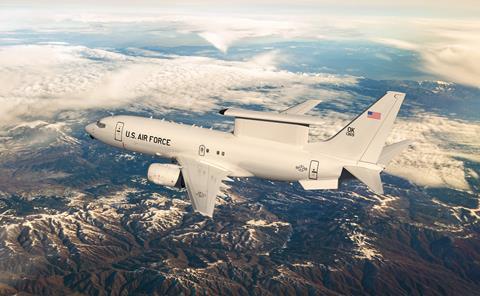
A group of retired generals from the US Air Force (USAF) are publicly calling on lawmakers in Congress to override the Trump Administration’s plan to cancel acquisition of the Boeing E-7A Wedgetail airborne early warning and control jet.
In a letter published on 7 July via the Air and Space Forces Association (AFA), the 16 formerly high-ranking officers argue that Congress should fully fund the USAF’s existing plan to field 26 E-7As.
“Having a robust tracking and battle-management system is fundamental to projecting air power and winning conflicts,” say the group of retired officers. “Prudence demands we acquire sufficient numbers of E-7s to prevail whenever the next conflict unfolds.”
The signatories of the letter include five former USAF chiefs of staff and two NATO supreme allied commanders.
“There is a reason our allies, the United Kingdom, Australia, South Korea, Turkey and NATO have all decided to procure the E-7 for this crucial combat requirement,” the group notes.
Under the Biden Administration (and with some urging from Congress), the USAF had begun the process of fielding the Wedgetail to replace the ageing Boeing E-3 Sentry fleet, which is in the process of being retired.
However, officials at the Pentagon say the Trump Administration’s proposed fiscal year 2026 defence budget will zero out funding for the E-7A programme.
Instead, Washington will seek to purchase Northrop Grumman E-2D Advanced Hawkeyes to act as a temporary stopgap, while the Pentagon develops a space-based system for airborne threat-tracking and air battle management.
“We believe most of the [intelligence, surveillance and reconnaissance], or a great deal of the ISR in the future, will be space-based,” US secretary of defense Pete Hegseth told Congress in June.
Hegseth added that the Trump Administration’s defence team does not regard the E-7A as survivable in a modern combat environment.
While the signatories of the AFA letter did not specifically address the survivability concern, the retired officers argue against both the merits of the E-2D as an alternative to the E-7A, and the readiness of space-based systems to take over the mission.
“The E-2 is unable to meet the combatant command requirements for theatre-wide airborne command and control. That is not the mission for which it is designed,” the group says.
While the cohort says a space-based alternative for air battle management will likely be feasible in the future, the group says that technology is not yet ready to act as the primary provider of that service.
“The scientific and engineering hurdles to accomplish this goal are daunting and the timeline to success is unclear,” they say.

Congress is still in the early stages of debating the FY2026 budget. Lawmakers often override the policy and fiscal preferences of the Pentagon and administration, with such an outcome plausible in the context of the Wedgetail programme.
Boeing has already begun work on preparing two prototype E-7As for the USAF, with a handover expected in 2028. Those jets are meant to inform a final design and production decision.
Despite the current uncertainty, the chief executive of Boeing Defense, Space & Security Steve Parker has expressed confidence that the US Wedgetail programme will ultimately move forward.
“I believe E-7 Wedgetail will be in the US Air Force inventory in large numbers,” Parker told FlightGlobal in June at the Paris air show.
Parker also expressed scepticism at the notion that space systems are ready to replace the operationally proven capability of the E-7A.
“I think there’s certainly a debate in terms of what can be done from space… versus what can be done at the airborne layer,” he said.