













US defence contractor Sierra Nevada Corporation (SNC) has begun early-stage flight testing of the US Air Force’s (USAF’s) new E-4C Survivable Airborne Operations Center (SAOC) aircraft.
SNC on 3 September said it launched the flight-test campaign for the modernised nuclear command and control jet, with the inaugural sortie taking place on 7 August.
Based on Boeing’s 747-8, the new E-4C jet is meant to replace the USAF’s aged fleet of Boeing E-4B Nightwatch aircraft, which are capable of commanding the USA’s nuclear arsenal from aloft.
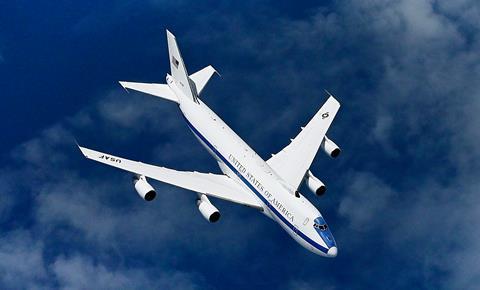
Over five decades of service, that grim duty led to the E-4B developing the moniker “Doomsday” jet.
During national emergencies or following destruction of ground-based command centres, E-4Bs can be platforms from which leaders coordinate civil authorities, direct US forces and execute war orders, including launching nuclear weapons.
SNC says initial E-4C test flights will help reduce engineering risks and “ensure on-time delivery” of the modernised fleet under the SAOC contract.

The Nevada-headquartered company secured that $13 billion deal in 2024, emerging as the sole competitor after Boeing withdrew its bid in 2023, citing an impasse with the USAF related to contract terms.
Both flight and ground testing of the initial E-4C example will continue into 2026, with the goal of establishing a technical design baseline. Test and development activities will primarily occur in Dayton, Ohio and Wichita, Kansas.
The USAF has not confirmed how many SAOC aircraft it plans to field. The service maintains a fleet of four E-4B Nightwatch aircraft, with an average age of more than 51 years.
SNC says it has received four 747-8 passenger jets, which the company is converting for military use. The E-4B predecessor was based on a heavily modified 747-200.
In 2024, SNC reached a deal with Korean Air to purchase five used passenger jets. That same year, GE Aerospace received a USAF contract under the SAOC programme to overhaul and upgrade GEnx-2B engines, which power 747-8s.
The Pentagon describes the ability to command the nation’s military forces – including its nuclear arsenal – from a mobile airborne station as critical to deterring adversaries from conducting strategic attacks against the USA or Washington’s allies and partners.
Delivery of the full E-4C SAOC fleet is scheduled to be complete by 2036.