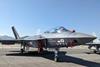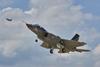













South Korea is accelerating plans to incorporate additional ground-attack capabilities in the Korea Aerospace Industries (KAI) KF-21 fighter.
Following the 2024 retirement of the McDonnell Douglas F-4 Phantom and pending retirement of its remaining Northrop F-5s, a key South Korean defence committee has cleared a revised Basic System Development Plan, according to the Defence Acquisition Program Administration (DAPA).
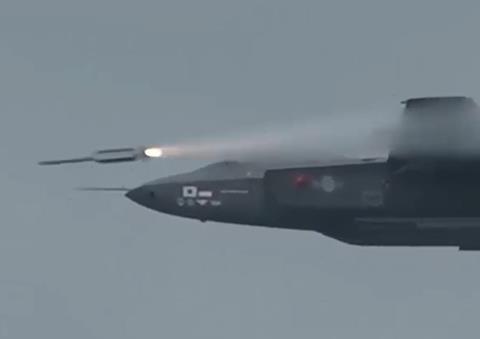
The updated plan brings forward air-to-ground weapons tests to the first half of 2027, compared with late 2028 under the previous schedule.
“This is expected to not only strengthen our military’s air power but also enhance the competitiveness of the aviation industry and expand defence exports,” says DAPA of the Defence Acquisition Program Promotion Committee’s decision.
The new capabilities fall under the aircraft’s Block II configuration. DAPA has not disclosed details of the air-to-ground weapons to be deployed on the KF-21.
The type has 10 hardpoints and a maximum payload of 7,700kg (17,000lb). It remains in flight testing, but KAI holds contracts to produce 40 examples for the Republic of Korea Air Force, which is to receive its first aircraft in late 2026.
Initial weapons work has focused on air-to-air armament, including the MBDA Meteor beyond-visual-range air-to-air missile.
Alongside its fighter modernisation work, the same committee also advanced a major maritime helicopter programme.
It approved a plan – first announced in late 2023 – to acquire new rotorcraft under the Maritime Operations Helicopter II (MOH II) programme, replacing Leonardo Lynx 99/99A maritime helicopters. DAPA has earmarked more than W3 trillion ($2.2 billion) for the effort, which will run from 2025 to 2032, and calls for a type able to “detect and rapidly attack underwater and surface forces, such as enemy submarines equipped with submarine-launched ballistic missiles”.
The Sikorsky MH-60R won the original MOH requirement for 12 helicopters, and South Korean media reports have identified the MH-60R and NH Industries NH90 as potential candidates for MOH II.
Cirium fleets data shows that the Republic of Korea Navy operates 22 Lynx 99s in the anti-submarine warfare (ASW) role with an average age of 34.7 years, plus 13 Lynx 99As averaging 25.3 years. Its ASW inventory also includes eight Leonardo AW159s (with an average age of 8.9 years) and five new MH-60Rs from the original MOH contract, with seven more on order.