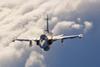














Swedish jet manufacturer Saab has finalised an agreement to sell Thailand an initial batch of four Gripen E/F fighters.
Saab on 25 August said it had signed a contract with Bangkok covering three single-seat Gripen Es and one two-seat Gripen F, a package worth SKr 5.3 billion ($556 million).
The deal had been approved by the Thai government earlier this month.
“We welcome Thailand as the latest customer for Gripen E/F,” says Micael Johansson, Saab’s chief executive. “Thailand has chosen the most-modern fighter on the market with which to build its next generation of strategic, independent capabilities.”
Saab expects to deliver the four aircraft to the Royal Thai Air Force (RTAF) between 2025 and 2030.

Bangkok is expected eventually to field 12 of the latest Gripen variants, with the additional eight aircraft to be covered under subsequent contracts.
Those jets will supplement older-model Gripens already operated by the RTAF, including one combat squadron of 11 Gripen C/D fighters. Also in the Thai inventory are 47 Lockheed Martin F-16A/Bs, 33 Northrop F-5Es and 18 Dassault/Dornier Alpha Jets.
Thailand sent F-16s and Gripens into combat in July during a conflict with neighbouring Cambodia over a disputed border. Those sorties, which are thought to be the Gripen’s first combat deployment, involved precision air-to-ground strikes.
Lockheed had pitched its latest F-16 Block 70/72 to Bangkok as an alternative to the Gripen E/F, but was ultimately unsuccessful.
Under its deal with the RTAF, Saab also committed to an industrial offset package that includes “significant transfer of defence technology” to Thailand, the company says.
That agreement calls for Saab to upgrade the RTAF’s two Saab 340B Erieye airborne early warning aircraft to an improved standard, aiding the service’s arial command and control capabilities. Offset work will be conducted locally in partnership with Thai Aerospace.
Saab will also help establish a research and development centre in Thailand, and Bangkok will gain access to the intellectual property rights of the Link-T data communication system that connects Gripen fighters.
Other direct offsets include upgrading Thailand’s ability to perform aircraft upgrade work, giving it a greater role in the Gripen E/F supply chain, and improving Thailand’s maintenance capabilities.