











The lighter side of Flight International.
Reviving Pan Am
Attempts to relaunch Pan Am – one of the most legendary brands in aviation – have come thick and fast since the airline’s collapse in 1991.Recent months have seen two.
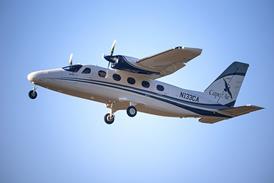
You might have done a double-take this summer if you looked up and spotted an aircraft in the familiar blue livery. A high-end tour operator has been offering air voyages that aim to “revive the glamour of travel’s golden age” using a Pan Am-liveried, former Icelandair Boeing 757 (a type the original airline never flew), and with crew sporting retro uniforms. It operates under a licence from Pan American Global Holdings, which trades as Pan Am Brands, the business that owns rights to the Pan Am identity.
Beyond Capricorn’s first trip in June took in iconic Pan Am destinations, including Bermuda, Lisbon, Marseille and Foynes in Ireland, the first stop eastbound for Pan Am’s pre-war transatlantic flying boats. A second Pacific tour is planned.

Meanwhile, finance provider Avi8 Air Capital is collaborating with Pan Am Brands to relaunch the airline itself, although things are very much at an “exploratory stage”. Avi8 says it is working with the licence holder “to assess the feasibility, structure and financial strategy for the airline’s return to commercial operations”. Updates are promised in the “coming months”.
Avi8 has an existing connection to the Pan Am brand. Its managing partner Ed Wegel became chief executive of Miami-based Pan Am Flight Academy – the last remnant of the old airline still trading – when it was taken over by another finance company, Acorn Capital Management, earlier this year.
We wish both more success than earlier bids to bring Pan Am back to the skies. The nineties and noughties witnessed the launch of at least three short-lived US domestic operators using versions of the name. In 2010 there was another blink-and-you’d-have-missed-it venture, Pan American Airways, a cargo operator based out of Brownsville, Texas.
Nearly 35 years after the original airline’s disappearance, it seems there is still a deep fondness for a brand that, in its heyday at least, epitomised the carefree luxury of international commercial flight. But is that nostalgia for an era before sardine-can air travel enough to support a business case for bringing Pan Am back?
Scorched earth
With the main themes at mid-July’s excellent Royal International Air Tattoo including marking the 50th anniversary of the Apache attack helicopter’s first flight in prototype guise, it was only fitting that two UK-operated examples should made their, er, mark while visiting RAF Fairford.
Two of the Army Air Corps’ AH-64Es, along with a Leonardo Helicopters Wildcat, performed a stunning role demonstration on the show’s opening day, supported by an impressive amount of pyrotechnics.

However, with the grass next to the runway’s northern taxiway having been left tinder-dry by a lengthy spell of unusually hot weather, the enthusiastically scaled wall of flames, which was ignited as the routine neared its explosive conclusion, sparked a major blaze that resulted in masses of smoke as hundreds of metres of the ground was scorched black.
Perhaps the visiting team had misread the venue as being named RAF Fireford?
Southwest scraps anarchy in the aisle
Southwest Airlines, inventor and last hold-out of the boarding free-for-all, is introducing assigned seating.
All no-frills airlines since the 1990s have to some extent aped the original model devised by the Texan carrier’s founder Herb Kelleher of offering the lowest fares possible by operating a single-type fleet on point-to-point routes, stripping out all unnecessary costs, and sweating assets by having aircraft at the gate for as little time as possible.
European pioneers EasyJet, Ryanair and Wizz were all disciples. However, during the previous decade each of them abandoned arguably the most unpopular aspect of the Southwest model – unassigned seating – judging that any (debatable) time savings were more than offset by dislike of the Darwinian jostle in the aisle, and the despair of couples or families with kids placed 20 rows apart.

Of course, the low-cost carriers (LCCs) did not scrap unassigned seating out of concern for passengers. One by one, they realised that charging to choose a seat was a lucrative ancillary revenue generator; Southwest appears to agree.
Mercifully, none of the LCCs have gone down the road of putting a price on using the lavatory, although this was something proposed by Ryanair’s Michael O’Leary in 2009, who wanted to replace two of the toilets with an extra row of seats, and charge passengers a pound (or equivalent) to spend a penny.
From yuckspeak to tales of yore, send your offcuts to murdo.morrison@flightglobal.com