














The US Air National Guard (ANG) has assessed the ability of combat search and rescue (CSAR) helicopters to defend themselves against fighters over open water.
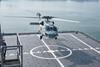
In an undated exercise, a National Guard Boeing F-15D fighter conducted a simulated engagement against a Sikorsky HH-60G Pave Hawk and HH-60W Jolly Green II, according to the ANG.
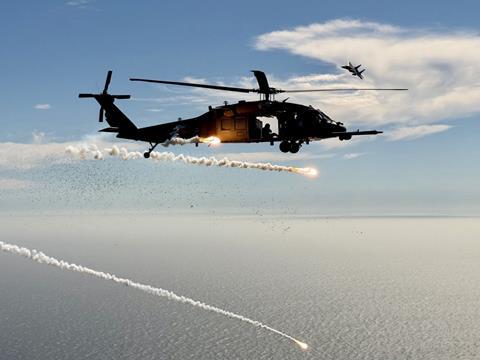
The two helicopter types are fundamental to the US Air Force’s (USAF’s) ability to rescue pilots who have been forced to eject in combat. The engagement with the fighter tested their ability to defend against modern fighters.
The ANG did not release details about the tests, such as whether the F-15D succeeded at disrupting the helicopters’ mission or even shooting them down. A key element of the work involved the helicopters’ electronic countermeasures systems.
“The HH-60W has never undergone this type of evaluation,” says USAF Lieutenant Colonel Don Smith, of the ANG.
“This test data will help us determine how effective US countermeasures are against fighter aircraft over water.”
Data generated from the work will go into enhancing the survivability of rescue helicopters.
The work has clear applications should a conflict break out in the western Pacific.
The rapid militarisation of China and Beijing’s increasing belligerence have raised the possibility of war. Contingencies that might result in US intervention could include an attempted Chinese invasion against neighbouring Taiwan, or Chinese military action against US allies such as Japan, the Philippines, or South Korea.
In such a conflict US pilots would find themselves operating over vast expanses of water. This creates the possibility that US and allied forces may need to conduct over-water CSAR missions in contested airspace.
First delivered in 2020, the HH-60W is an enhanced version of the US Army’s UH-60M Black Hawk, and is the replacement helicopter for the HH-60G.
The new model has additional fuel tanks, giving it an unrefuelled 195nm (361km) combat radius. It also comes with systems to protect against surface-to-air missiles, including digital radar warning receivers, a laser warning system and a missile and hostile fire warning system.