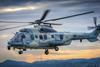














Airbus is challenging claims that its UH-72A Lakota helicopter is ill-suited for its current role as the US Army’s primary pilot-training aircraft.
Senior army leaders have pointedly criticised the H145-based twin-engined rotorcraft as too complex and featuring too much automation to effectively impart basic flight skills.
The army has also linked an increase in serious rotary-wing accidents to adopting the UH-72A as its primary trainer in 2020.
Airbus’s competitors have cited those talking points as they seek to promote alternatives to the UH-72A for the army’s Flight School Next contract. That programme seeks to reform the army’s entire flight training curriculum, complete with a new fleet of “contractor-owned/contractor-operated” (COCO) aircraft to replace Lakotas.
Revenue from Flight School Next is estimated to be around $1.5 billion annually.
But Airbus is now pushing back, arguing that claims of the UH-72A’s unsuitability are both inaccurate and addressable.
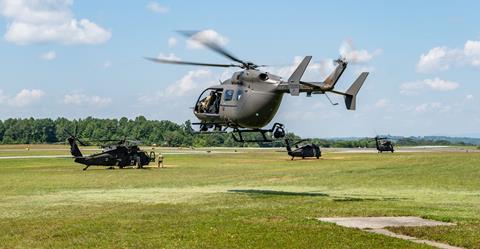
A key Lakota criticism – that it has too much automation – is easily remedied at no cost, says Airbus.
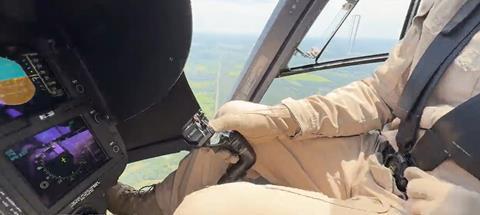
The UH-72A’s stability augmentation system (SAS) can be modulated between five levels of pilot-assisted automation via an existing cockpit switch.
“Right there, on the cyclic where your thumb kind of rests comfortably, is a round little switch,” says Stephen Burns, director of Washington operations for Airbus US Space & Defense. Burns previously flew Sikorsky UH-60 Black Hawks in the US Army and commanded a helicopter battalion.
“From that, you can go from all of the stability and autopilot on to off – period,” he says. “Just like that – no cost, no effort – from full augmentation to none.”
An informational video released by Airbus in July shows this feature in action.
“Students manually control every aspect of flight control inputs,” the video’s narrator says, after showing a pilot engaging the SAS cut-off.
The video also lays out the Lakota’s five levels of variable automation, suggesting this capability in fact makes the UH-72A ideal for the training mission – allowing trainees to gradually add in more advanced stabilisation assistance as their flight proficiency improves.
Burns notes that the UK Royal Air Force (RAF) flies its H145 training flights with the automation inactive. Indonesia has also gone with H145s as trainers, ordering four in 2024.
Numerous countries – Japan, Germany, Spain, Australia, Switzerland, Italy, and Canada – train pilots in other twin-engined helicopters like Airbus H135s, Leonardo AW139s and AW169Ms, and Bell 206s and 412s.
The RAF operates H145s under the designation Jupiter HT1 as an advanced trainer. London is apparently satisfied with the type, adding to the existing fleet of seven trainers in 2024 with an order for six more H145s to serve frontline missions.
The first of those additional Jupiter helicopters was delivered the RAF in May.
A source within Airbus, speaking on the condition of anonymity, tells FlightGlobal the US Army has not explored incorporating the SAS cut-off capability into its flight school curriculum.
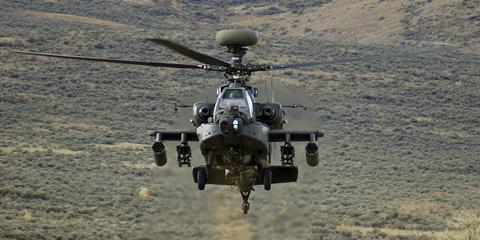
Top army generals, including the service’s chief of aviation, have said pilot trainees are not learning basic “stick-and-rudder” flying skills in Lakotas, leading them to make potentially fatal mistakes when they begin flying the larger, more-powerful frontline models like Boeing AH-64E attack helicopters.
“A lot of what I’m hearing is: they’re great system operators, but they don’t know how to fly the aircraft,” Major General Clair Gill, the army’s top aviation officer, told FlightGlobal in May.
Vice chief of staff General James Mingus, the service’s number two general, levelled similar critiques. “We took a very sophisticated aircraft that almost flies itself and used that to train basic pilot skills,” he said at the annual Army Aviation Association of America conference.
The army has specifically cited inability for students to practise emergency autorotations to the ground in UH-72As.
That is because army regulations forbid performing non-emergency autorotations to the ground in twin-engined helicopters due to concerns about costly damage. The thinking is that the odds of a dual engine failure are so remote as to not be worth the risk.
Students practise autorotations in UH-72As but stop short of the ground.
Senior leaders such as Mingus have made clear they want a new trainer that does not carry such limitations.
“We want to go to a simple, single engine, basic helicopter,” the vice-chief said in May. “We want [pilots] to be masters of their craft… being able to fly a helicopter in the old fashioned way, so that all that becomes instinctual.”
Citing his experience as a wartime rotary-wing commander, Airbus’s Burns says the army’s frontline units already do not practice autorotations to the ground.
“It is a manoeuvre that they’re not going to have to duplicate or do again later in their careers,” he notes.
All of the US Army’s combat rotorcraft have two engines.
Burns says shifting to a simpler, single-engined trainer may offer some perceived advantages but comes at a cost – particularly as the army prepares to field its first batch of significantly more complex Bell MV-75 tiltrotors.
“It’s not as easy as everybody thinks, jumping into a single engine,” he notes.
The Airbus executive and former US Army pilot says the service’s use of twin-engined rotorcraft for operational roles negates arguments that new pilots need to practise autorotation on single-engined aircraft.
Airbus has also cited the UH-72A’s sterling safety record in the trainer role, with no fatal accidents over five years and 800,000 flight hours as the US Army’s primary rotorcraft trainer.
Another goal of the Flight School Next programme is to consolidate four contracts for supporting the army flight school at Fort Rucker, Alabama into a single deal headed by one prime contractor. This, the service says, will significantly reduce costs, which have ballooned under the current approach.
Burns agrees consolidation is necessary, but says ditching army-owned UH-72As for a new contractor-owned fleet may not produce the anticipated cost savings over the long-run.
Officials with the US Army’s fixed-wing intelligence, surveillance and reconnaissance (ISR) task force have said contractor-owned and -operated aircraft can be more expensive to operate over time than government-owned aircraft.
The army has several COCO contracts in place to operate modified Bombardier business jets as long-range ISR platforms. These are to be phased out when the service receives Bombardier Global 6500 jets modified by Sierra Nevada Corporation.
Airbus and other contenders for the Flight School Next Deal, including Bell, Leonardo and Lockheed Martin, have argued they can reduce overall costs for the army.
Competition for the contract has become fierce. Flight School Next is the US military’s only major rotary-wing sales opportunity for the foreseeable future.
The army selected Bell to provide its new MV-75 Future Long-Range Assault Aircraft tiltrotor, cancelled development of an armed scout and doubled down on existing models, planning to operate UH-60Ms, Boeing CH-47F Block IIs and AH-64Es for decades more.
Meanwhile, the US Navy’s trainer fleet recapitalisation is nearly complete with the purchase of 130 Leonardo TH-73s – a derivative of the AW119k light-single – and the US Coast Guard plans to acquire more Sikorsky MH-60T Jayhawks rather than buy a new type.
There are scant opportunities elsewhere in the navy, US Marine Corps or US Air Force. All three services have nearly completed building fleets of Bell-Boeing V-22 tiltrotors that will serve for decades.
The limited field for new business has raised the stakes on the army’s trainer programme, with much of the rotary-wing industry seeking a win.