














The California state fire agency is partnering with rotorcraft manufacturer Sikorsky to explore how autonomous vertical-lift solutions can improve wildfire response.
Under a five-year initiative announced on 3 September, Sikorsky and CalFire plan to test the integration of autonomy-enabled aircraft into firefighting operations. Through the project they aim to reduce pilot workload, improve situational awareness and give first responders better options for operating in dangerous and deteriorating conditions, including periods of limited visibility.
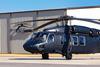
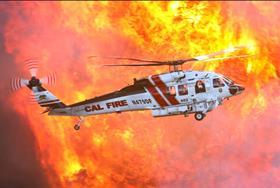
In particular, the partnership will explore development of Sikorsky’s autonomous-capable S-70i Firehawk, a firefighting derivative of the company’s prolific UH-60 Black Hawk military helicopter.
Sikorsky says the rotorcraft’s military origins make it uniquely robust and suited for operating in harsh conditions common to wildfire suppression flights. The medium-twin can fly at speeds up to 155kt (287km/h), operate in high winds and reach altitudes of 10,000ft – a useful asset in a region where much of the mountainous interior is higher than 5,000ft.

Each night-vision-capable Firehawk comes with a 3,785 litre (1,000USgal) water tank and retractable snorkel. The helicopter’s cabin can be configured for different missions.
CalFire already operates the S-70i as its primary rotary-wing asset, with 16 Firehawks in service. Sikorsky delivered the final two in July.
“CalFire is excited to collaborate with Sikorsky and determine how their advanced technologies could benefit our helicopter and uncrewed aerial system programmes,” says Steve Robinson, assistant deputy director for aviation at the agency.
Sikorsky says its autonomous flight technology will be a “game changer” for California’s firefighting efforts.
“By leveraging cutting-edge technologies and enhancing the safety and efficacy of operations, this collaboration has the potential to revolutionise the way we respond to wildfires,” says Rich Benton, general manager of Sikorsky.
The Lockheed Martin subsidiary in April conducted demonstrations of its Matrix autonomous flight system for CalFire using a Black Hawk outfitted with a firefighting system developed by start-up Rain.
Sikorsky has proven the ability to modify and fly a standard UH-60A without an onboard pilot as far back as 2022, with a focus on military missions like casualty evacuation and resupply. The company received a contract in 2024 to convert one its newer UH-60M-model Black Hawks for autonomous operations.
Alameda-based Rain offers its own flight autonomy software that is narrowly focused on firefighting operations. The software can find and track fires, develop suppression plans and autonomously navigate aircraft to drop water on targets.
The two-week test event held by Sikorsky and Rain in April marked the first deployment of autonomous wildfire suppression technology in California.
The demonstration also saw an autonomous aircraft and human-piloted helicopter operate simultaneously in the same fire traffic area – another first.
Sikorsky says pilots from CalFire and a number of local firefighting agencies in California have travelled to the company’s headquarters in Stratford, Connecticut for familiarisation with its optionally piloted Black Hawk demonstrator.
That technology allows an aircraft to perform conventional and autonomous flight, with the fly-by-wire Matrix autonomous flight control system added into the UH-60’s conventional cockpit and mechanical flight controls.
Sikorsky is betting significantly on advanced technologies like uncrewed rotorcraft, autonomous flight and hybrid-electric propulsion, as its largest customer – the US Army – begins modernising its rotorcraft fleet and moves toward winding down Black Hawk purchases.