











The Spanish armed forces have successfully tested the concept of integrating small drones with the country’s manned rotorcraft.
One trial involved the Spanish navy’s Airbus Helicopters H135s, while a separate effort featured the army’s NH Industries NH90 helicopters.
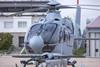
Airbus Helicopters on 7 November revealed that it successfully integrated the company’s Flexrotor small uncrewed aircraft with a Spanish navy H135 during trials in May.
The vertical take-off and landing Flexrotor is a Group 2-size uncrewed aircraft geared for intelligence, surveillance and reconnaissance missions.
As part of the effort, Airbus Helicopters outfitted a Spanish H135 with new antennas and a modem, allowing the onboard crew of the rotorcraft to receive information feeds directly from the Flexrotor drone in flight, which Airbus says will allow for “extending visual range and mission safety exponentially”.
“The association with the Flexrotor converts the helicopter into a force multiplier, enabling rapid collection and distribution of data in real time to allow informed decision-making, and also reduces the crew’s exposure to dangerous and no-go areas,” says Luis Martin Diaz, head of customers and programmes at Airbus Helicopters in Spain.
The test flights were carried out at Coronel Mate Spanish army air base in Madrid.

Separate tests conducted in September saw a Spanish army NH90 integrate with an Q-SLAM-40 loitering munition designed by Spanish technology and manufacturing firm Arquimea.
The tube-launched, man-portable Q-SLAM-40 can be used for lethal strike targeting, as well as battlefield surveillance and reconnaissance.
Airbus Helicopters, which is a partner in NH Industries alongside Leonardo and GKN Fokker, says the NH90 integration flights used the rotorcraft’s cargo hook hatch to air-launch a Q-Slam-40 downward through the ventral access point.

Onboard crew then controlled the loitering munition via a mission systems tablet.
With a flight endurance of 25min and one-way range of 13.5nm (25km), the weapon allows NH90 crews to deliver “controlled, surgical strikes” while remaining safely removed from enemy targeting.
“Its ability to form drone swarms opens up a new array of possibilities for the NH90’s classic attack missions but also for scenarios of emerging importance, such as coordinated strikes against other drones,” Airbus Helicopters says.
Spain is in the midst of a significant expansion of defence spending, with Madrid approving a €3.7 billion ($4.3 billion) military procurement package in September that includes funds for 45 Turkish Aerospace Hurjet trainers and 18 Airbus Defence & Space C295 fixed-wing transports.
A sizeable number of rotorcraft were also included, notably 32 NH90s – potentially armed with guided missiles and rockets – and 13 of the H135 light-twins to be used as training and support assets. The package also includes 54 of an undisclosed light-twin helicopter type – likely to be the H145M – and six H175 super-mediums for VIP transport missions.