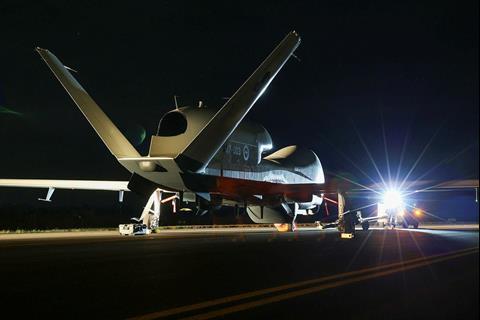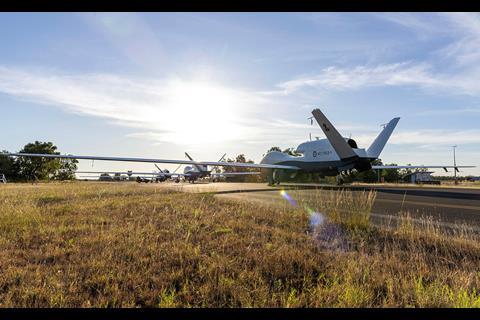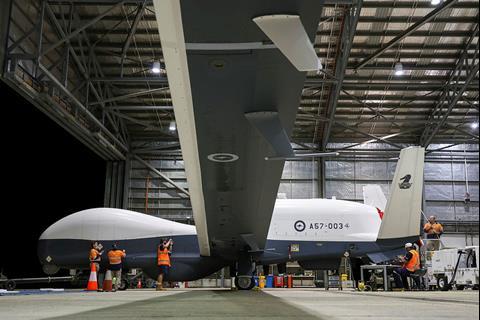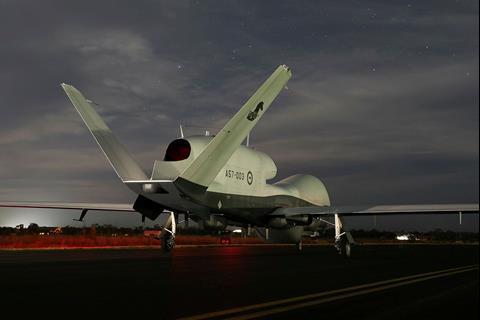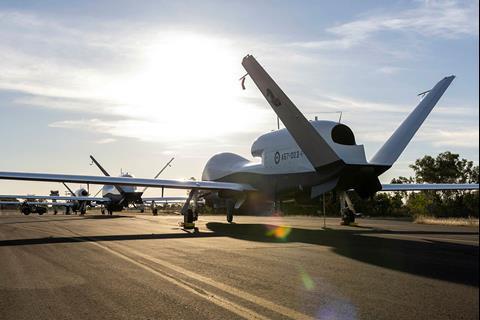













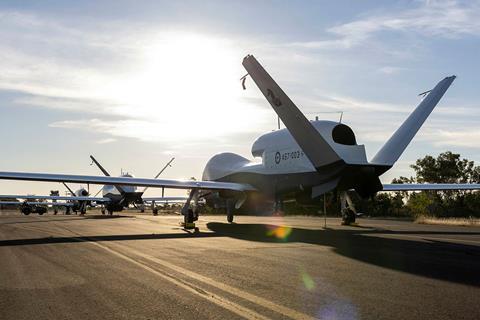
Australia’s new fleet of remotely piloted maritime patrol aircraft is nearly complete.
Manufacturer Northrop Grumman says work is underway on Canberra’s fourth and (for now) final MQ-4C Triton, after the company delivered the second and third examples earlier this year.
The two long-range, long-endurance vehicles arrived at the Royal Australian Air Force’s (RAAF’s) Tindal base in its Northern Territory in May, after being ferried from US Naval Air Station Patuxent River in Maryland. The MQ-4Cs accomplished the transfer under their own power, flying a a multi-day, multi-leg journey across the Pacific Ocean.
Australia had received its first MQ-4C in July 2024 and has since successfully completed its first test flights under the control of the RAAF.
RAAF chief Air Marshal Stephen Chappell says the Triton platform delivers “unprecedented persistence and awareness over Australia’s extensive maritime domain”.
“This acquisition clearly demonstrates the ongoing success of the cooperative programme with the United States Navy [USN], and strengthens our integrated focused force,” he adds.
The USN operates its MQ-4Cs alongside a fleet of manned Boeing P-8A Poseidon jets, which perform anti-submarine warfare and maritime patrol missions. Australia has also adopted this framework, with plans to operate 14 P-8As in conjunction with its four Tritons.
In addition to intelligence, surveillance and reconnaissance support, the MQ-4C can provide its own anti-submarine capability and has options for electronic warfare.
Brad Champion, Northrop’s MQ-4C programme director, says the remotely piloted vehicle can monitor 4.2 million square nautical miles during the course of a single flight, cruising at altitudes of 50,000ft.
”There really isn’t another platform like this from a maritime intelligence perspective,” Champion says.
Powered by a single Rolls-Royce AE3007H turbofan, each Triton boasts a range of 7,400nm (13,700km), with a flight endurance of more than 24h.
“The delivery of Australia’s second and third Triton aircraft will enable commanders and strategic decision makers to see farther, fly longer and act faster against current and emerging threats,” says Jane Bishop, Northrop’s general manager for global surveillance.
Northrop expects to deliver the fourth Australian MQ-4C in 2028. Publicly available defence strategy documents indicate Canberra could ultimately expand that fleet to reach seven aircraft, although that remains a matter of discussion.
Whatever their final number, the RAAF’s Tritons will be stationed south of Darwin on Australia’s Top End northern coastline – closest to strategic maritime approaches like the South China Sea, Philippine Sea and Strait of Malacca.
However, the pilots flying the MQ-4C fleet will be on the opposite side of the continent at RAAF Base Edinburgh near Adelaide, South Australia – some 1,390nm (2,570km) to the south and far removed from any potential conflict.
A crew of five ground operators control each Triton via secure satellite link. Each team includes an air vehicle operator, tactical coordinator, two mission payload operators and a signals intelligence coordinator. The towable trailer-based ground control station can be moved to forward locations as needed.
The US military has successfully tested moving an MQ-4C control centre via Boeing C-17 transport, a capability which the Pentagon says allows the Triton to support operations “from nearly any US facility in the world”.
The long-endurance capability of the MQ-4C will be critical to reducing workload on the limited fleet of manned P-8As by monitoring the many waterways by which an adversary’s naval forces could approach Australia.
That risk was on display earlier this year, when a Chinese military flotilla circumnavigated the Australian continent on a 12,000nm voyage that included unannounced live fire exercises southeast of Sydney and incursions into Australia’s exclusive economic zone.
The brazen expedition, which brought the Chinese warships to within 170nm of the city of Perth, came shortly after the top American military officer in the Indo-Pacific has warned that Beijing appears to be preparing its forces to take control of Taiwan.
“Their aggressive manoeuvres around Taiwan right now are not exercises as they call them,” said Admiral Samuel Paparo at the Honolulu Defense Forum in February. “They are rehearsals for the forced unification of Taiwan to the mainland.”
If Washington decided to respond militarily to such a contingency, maritime surveillance aircraft like the MQ-4C and P-8A would be critical in detecting Chinese submarines in the waters around Australia, which would be important approaches for US military equipment and personnel flowing into the region.
See more photos of Australia’s three MQ-4C aircraft: