














GE Aerospace and Kratos have concluded high-altitude testing of a small jet engine intended to power uncrewed fighter aircraft.
The pair, which announced their intent to jointly develop the GEK800 turbofan in 2024, said on 31 October they had successfully completed altitude stand testing of the new engine.
GE told FlightGlobal in September it had begun the GEK800 laboratory testing at Purdue University in Indiana, focusing on simulated altitudes of 5,000-35,000ft.
The trials also included durability and limits testing.

“This collaboration has been instrumental in advancing the engine’s development, validating its performance and accelerating its path toward production,” says Stacey Rock, president of Kratos Turbine Technologies.
“Together, we’re delivering on our shared commitment to provide high-performance, affordable propulsion systems that can be rapidly produced to meet the demands of our defence customers,” she adds.
Kratos and GE teamed up to offer a propulsion solution for the burgeoning class of lightweight, low-cost tactical jets designed to operate without onboard pilots.
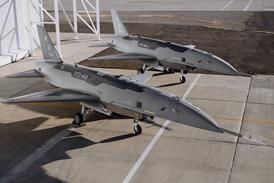
The US Air Force is leading development of the so-called Collaborative Combat Aircraft (CCA), with prototypes from General Atomics Aeronautical Systems and Anduril Industries currently in flight trials.
Key to meeting cost and production volume goals of the CCA concept is finding an engine that can meet the more modest aerodynamic performance needs of an uncrewed tactical jet, but at a significantly lower cost than conventional fighter engines.
GE and Kratos were early movers into that space with the GEK partnership, but numerous of other engine makers have since followed, including Pratt & Whitney, Honeywell, Rolls-Royce and several small start-ups.
The 800lb (3.6kN)-thrust GEK800 will be closer in class to a business jet engine than to a traditional low-bypass turbofan for a fighter jet.
“Our joint team successfully expanded the altitude testing envelope and identified the engine’s rotor speed limits and compressive system boundaries,” says Mark Rettig, general manager of GE’s Edison Works advanced projects unit. “This testing further demonstrated the engine’s outstanding performance and durability.”
The Williams FJ-44 business jet engine has emerged as one of the few existing options in the appropriate thrust and weight class for CCAs. That engine powers the Anduril YFQ-44A prototype, which is a finalist for the first US Air Force CCA contract.
General Atomics says its own YFQ-42A is compatible with at least 13 commercial jet engines, although the company has not disclosed which powerplant is currently flying on the prototype.
Kratos says the recent high-altitude testing met “nearly all” test objectives while also validating the ability to conduct this style of testing within Purdue’s newly commissioned lab facility.
In June, Kratos announced plans for a new factory in Oklahoma to fabricate the new line of GEK turbofans, which include the 800 and a larger GEK1500 – so named for their target thrust.