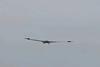















An image has emerged from China showing what appears to be a tailless unmanned air vehicle (UAV) with a high aspect ratio, as further evidence surfaces of the anti-ship role played by operational UAVs in Chinese kill chains.
The photograph, taken from behind, shows the UAV with landing gear deployed. Control surfaces, including flaps, appear to be visible.

Online observers have tentatively labelled the type WZ-X. It is possible this is the same aircraft spotted earlier this year in a Planet Labs satellite image of Malan air base in Xinjiang.
The UAV’s proportions suggest a resemblance to the USA’s highly secretive Northrop Grumman RQ-180. The long span points to a design optimised for flight at extreme altitudes.
Very little is known about the RQ-180, which is believed to undertake missions including intelligence, surveillance and reconnaissance, electronic warfare, and communications relay.
Given Beijing’s emphasis on kill chains linking sensor platforms – such as airborne early warning aircraft and stealthy UAVs – with units capable of conducting kinetic strikes, the value of a survivable high-flying platform is apparent.

The provenance of the new image – as with much material appearing on Chinese social media – is uncertain.
Separately, a Chinese television documentary has shed more light on the Guizhou WZ-7, a jet-powered UAV that has patrolled near Japan and Taiwan.
The programme, part of the Forging Ahead series and titled Exploring New Domains, also features segments on China’s new aircraft carrier CNS Fujian and the use of drones by Chinese ground forces.
The WZ-7 is shown operating in overcast conditions and identifying two enemy ships.
“Through thick clouds, we precisely locate the targets and analyse them in lightning time,” says one speaker. “Intelligence systems determine the target’s nature and immediately report this to leadership.”
The speaker adds that modern warfare requires intelligence about enemy positions to be updated every second, rather than in minutes as previously.
The documentary comes as China prepares for a major military parade on 3 September to mark the end of the Second World War. The event is likely to feature a vast range of Chinese military gear, including aircraft and UAVs.