












Northrop Grumman has unveiled its concept for an uncrewed fighter aircraft, adding another offering to the increasingly crowded space.
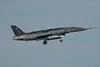
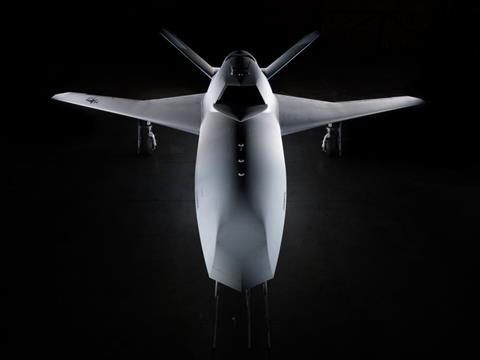
The company formally revealed the Talon on 4 December, describing the small jet as being oriented toward supporting manned air dominance fighters with an “adaptive, collaborative teammate”.
“Project Talon expands previous boundaries of collaborative aircraft technology to give US and international customers the ability to project power in dynamic threat environments,” Northrop says.
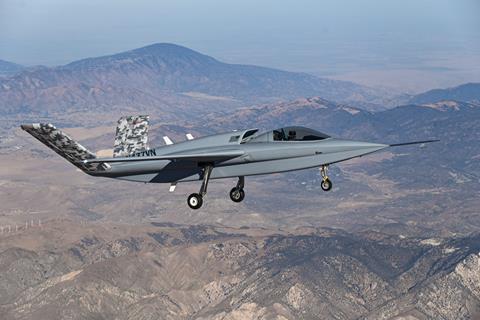
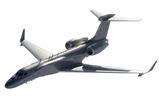
An image of the Talon prototype reveals an outer mould shape highly similar to the Scaled Composites Model 437 Vanguard. That small, low-cost jet was developed by the Northrop subsidiary for optionally autonomous operations.
The crewed Model 437 logged its first flight in 2024. Northrop is using an unmanned-capable example as a flying testbed for the company’s Beacon project to evaluate and mature new technologies for autonomous flight.
Both the Model 437 and the new Talon design feature a single dorsal-mounted air intake, swept wings and V-tail vertical stabilisers.
Those are all features also present on the General Atomics Aeronautical Systems YFQ-42A, which is a finalist to become the US Air Force’s (USAF’s) first Collaborative Combat Aircraft (CCA) – the designation for a new generation of semi-autonomous, uncrewed fighter jets. Anduril Industries also is pursuing that opportunity with its rival YFQ-44A.
Northrop’s Talon image does not show the aircraft’s ventral fuselage, which could offer hints as to whether or not the design features internal weapons bays.
However, in a concept for an uncrewed fighter based on the Model 437 shape released in 2021, Northrop suggested the design would offer the ability to carry stores both internally and externally, beneath the centreline and wings.
During the first flight of the Model 437 in 2024, Northrop said the jet features two internal weapons bays, each sized to accommodate two Raytheon AIM-120 advanced medium-range air-to-air missiles.
General Atomics’ YFQ-42A can carry munitions internally, while Anduril’s YFQ-44A does not.
Northrop says its jet is on track to fly in less than 24 months from the inception of design work. That timeline would put the start of Project Talon roughly around April 2024 – when Northrop was passed over for the CCA increment one contract.
Defence giants including Boeing, Lockheed Martin and Northrop briefly competed in the first phase of the USAF’s CCA development effort, which launched in January 2024. A few months later, the service advanced the two designs from Anduril and General Atomics to prototype building and flight testing.
However, the air force has a second increment of CCAs in the works, with design and capability requirements currently being developed.
Defence industry sources tell FlightGlobal the USAF is currently considering a two-tiered approach for increment two CCAs, with one jet being larger and more capable, while the other is smaller and lower-cost.
Manufacturers who were passed over for the first wave of uncrewed fighter development have spent the ensuing years refining their offerings based on feedback from the 2024 decision process.
The former head of Lockheed’s Skunk Works unit told FlightGlobal in 2024 that Lockheed offered a “gold plated” CCA design for increment one, prioritising survivability and capability over cost control.
The company does not appear to have walked back from that approach.
In September, Lockheed unveiled the Vectis – a tailless, low-observable uncrewed jet optimised to integrate with the company’s F-35 manned stealth fighter.
Northrop’s early comments on the Talon indicate a potentially different approach, one more focused on price point and speed of production.
The company says the Talon project incorporated what it calls “advanced modular manufacturing techniques”.
“This disruptive approach shortens timelines, emphasising speed and simplicity,” Northrop says.
The original Model 437 was designed with cost control in mind, featuring 3D-printed parts and reduced hand tooling during assembly.
The emergence of another autonomous fighter design widens the already substantial lead in the space enjoyed by US manufacturers.
Traditional defence primes in Europe have little more than programmatic concepts at this point. Turkey’s Baykar is the only manufacturer with a flying vehicle – the Kizilelma – which recently completed an air-to-air missile test firing.
Baykar has a joint venture with Italian aircraft manufacturer Leonardo to build the Kizilelma and other Baykar designs at three locations in Italy.
Australia also has a single uncrewed fighter programme in advanced flight testing – the Boeing MQ-28 Ghost Bat – which the American airframer designed, built and tested in Australia under a partnership with the Royal Australian Air Force.
Canberra is currently weighing full-scale production of the MQ-28, as Boeing works toward test firing an air-to-air missile from the autonomous jet.
China also has a number of uncrewed combat jets in various stages of development and flight testing, including the tailless GJ-11 and supersonic WZ-8, although little is known about these experimental types.

![[Photo4] AESA radar mounted on a platform simulator for ground-based functional and performance testing before flight trials](https://d3lcr32v2pp4l1.cloudfront.net/Pictures/100x67/3/4/5/115345_photo4aesaradarmountedonaplatformsimulatorforgroundbasedfunctionalandperformancetestingbeforeflighttrials_783684.jpg)