














The US military plans to buy tens of thousands of low-cost guided rockets from weapons manufacturer BAE Systems as part of the Pentagon’s effort to combat cheap battlefield drones.

A contract with BAE announced on 28 August covers the purchase of up to 55,000 Advanced Precision Kill Weapon System (APKWS) II rockets at a cost of $1.7 billion. Deliveries are to run through end-2031.

The 70mm (2.75in)-diameter APKWS has been in service for decades as an unguided air-launched munition. More recently, the improved APKWS II added a semi-active laser-guided capability to the rocket.

APKWS rockets c US Army

Source: US Army

At roughly $35,000 per round, APKWS rockets cost far less than long-range missiles traditionally used by ground-based air defences and fighter interceptors

Initially an air-to-ground weapon carried by attack helicopters like Bell AH-1Ys, Boeing AH-64D/Es and AH-6s, the APKWS has found a new niche: defending against lethal drones.

Recent modern conflicts, including the 2020 Nagorno-Karabahk war, the Russia-Ukraine war and hostilities between Israel and Iran have ushered in an era of drone warfare.

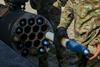
VAMPIRE-Marketing-Photos_SOFIC_FINAL_05_edit (1)

The L3Harris Vampire was an early counter-UAS solution to adopt the APKWS rocket

Small, commercially available quadcopters were first used for reconnaissance and artillery spotting, later being converted into lethally-armed attack weapons.

Ukrainian operators of so-called “first-person view” drones have struck armoured vehicles and inflicted casualties on Russian troops. The quadcopters were central to the secret Ukrainian intelligence operation that destroyed a significant portion of Russia’s strategic bomber fleet earlier this year.

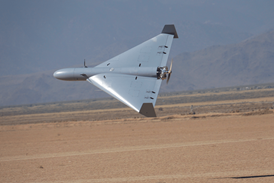
Russia and Iran have pioneered use of long-range “suicide” or “kamikaze” drones – also called “one-way unmanned aerial systems” – to bombard cities and sensitive infrastructure.

Such weapons are comparatively cheap and easy to produce, and both sides of the Russia-Ukraine conflict have been churning them out by the thousands.

Facing off against such swarms, traditional air defences can be quickly overwhelmed, with defenders exhausting supplies of expensive interceptor missiles.

Seeking solutions to this imbalance, the Pentagon and its suppliers are increasingly turning to APKWS IIs.

“That small-scale size gives a really good price point per shot,” Jason Lambert, president of intelligence, surveillance and reconnaissance for defence manufacturer L3Harris, told FlightGlobal in 2024.

L3Harris produces the Vampire counter-UAS system – a simple ground-based defensive system that pairs an APKWS launcher with an L3Harris Wescam MX-10D digital sensor and laser designator. The Vampire was one of the earliest military systems provided to Ukraine by Washington during the opening months of the war.

L3Harris is also exploring a ship-based version of the Vampire for naval drone defence.

APKWS rockets cost about $35,000 each. Guided missiles like Raytheon’s AIM-120 AMRAAM, AIM-9X Sidewinder and FIM-92 Stinger cost hundreds of thousands of dollars, even millions of dollars, each.

F-16 with APKWS rockets

Source: US Air Force

The US Air Force has integrated APKWS rocket pods into F-16 strike fighters

In addition to ground-based systems like Vampire, the Pentagon has developed air-launched counter-UAS applications for the APWKS. The US Air Force has successfully integrated the rockets with its Lockheed Martin F-16 fighters.

Paired with the F-16’s Northrop Grumman Litening targeting pod, fighter pilots in the Middle East have successfully used APKWS rockets to down one-way UAS launched by the Yemen-based Houthi militant group.

A BAE promotional video says APKWS rocket pods can be carried by more than 45 aircraft and helicopter types.

In July, the company also demonstrated the ability of small quadcopters to launch the rockets. Tests at the US Army’s Dugway Proving Ground in Utah saw a Malloy Aeronautics TRV-150 engage ground and air targets with a single, tube-launched APKWS rocket carried beneath its fuselage.

News of the Pentagon’s $1.7 billion APKWS contract comes as the US Department of Defense says it has created a task force to address the “growing threat of hostile drones” to personnel, equipment and facilities, both domestically and internationally.

“The small-UAS threat continues to grow exponentially and is becoming increasingly sophisticated,” a memo from defence secretary Pete Hegseth states.

Dubbed Joint Interagency Task Force 401, the group is intended to oversee all Pentagon offices and organisations working on the counter-UAS problem.