













The first Boeing MQ-25 autonomous refuelling aircraft will begin integrating with a US Navy (USN) aircraft carrier in 2026.

That will follow the expected first flight of the new uncrewed type later this year, according to the USN’s top aviation officer.

“MQ-25 will fly in 2025 and then do the integration on the carrier in 2026,” says Vice Admiral Daniel Cheever, commander of US naval air forces.

Known colloquially as the “air boss”, Cheever spoke on 26 August at an event hosted by the Center for Strategic and International Studies in Washington, DC.

Boeing previously confirmed plans to fly an initial engineering development model (EDM) of the MQ-25 before the end of 2025. The first MQ-25 aircraft (EDM-1) has been undergoing static ground testing for several months. Tail number EDM-3 will be the first example to fly, with EDM-2 delivered next.

These aircraft are distinct from the Boeing-owned test version of the MQ-25 (tail number T1) that logged its first flight in 2020. In addition to successful flights, the T1 example demonstrated the ability to transfer fuel to multiple USN aircraft, including the Boeing F/A-18E/F, Lockheed Martin F-35C and Northrop Grumman E-2D.

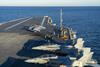
That test campaign included deck handling tests aboard the Nimitz-class carrier USS George HW Bush in 2021.

Boeing MQ-25 Stingray

Source: Boeing

Boeing and the US Navy carried out deck handling tests with a Boeing-owned MQ-25 prototype in 2021, but did not attempt launch or recovery from the carrier

More recently, Boeing and the navy have used simulations to integrate the MQ-25 into Raytheon’s automated carrier recovery system known as the Joint Precision Approach Landing System (JPALS). The technology was originally developed to facilitate the automated landing of short take-off and vertical landing F-35B fighters aboard the navy’s amphibious assault ships.

Notably, assembly work on Boeing’s MQ-25 production line in Mascoutah, Illinois is currently halted, with machinists at Boeing’s fighter aircraft manufacturing hub in the greater St. Louis, Missouri-area on strike.

That work stoppage has endured for a month, seemingly with little progress toward a resolution. It is unclear how the MQ-25 test schedule will be impacted if the strike drags on.

Assembly work on Boeing’s F-15EX, F/A-18E/F, and T-7A lines is also on hold.

The George HW Bush will be the first ship to begin working with new uncrewed tanker aircraft. In 2024, the USN outfitted the vessel with the first Lockheed Martin MD-5E ground control station (CGS) needed to remotely manage MQ-25 operations.

That system will form the heart of a new Unmanned Air Warfare Center (UAWC) onboard the navy’s carriers, which will enable operations with the Stingray and future uncrewed aircraft types.

“It really gives us the capability and capacity beyond what we have currently,” Cheever says.

Once fielded operationally, the MQ-25 will dramatically shake-up how USN carrier air wings operate.

Currently, fourth-generation Boeing F/A-18E/Fs serve as “buddy tankers” offloading fuel to fighters and other carrier-based aircraft needing extra range and loitering time.

While effective, that approach gives frontline commanders fewer combat aircraft to employ on tactical missions. It also increases wear on F/A-18E/F airframes.

The MQ-25 is set to change that formula, eliminating the need for embarked F/A-18s to act as refuellers.

“The freeing up [of] strike fighters to be strike fighters, and not have to do a tanking role, is the really exciting part of that,” Cheever says.

MQ-25 refuelling FA-18F - 3

Source: Boeing

The MQ-25 has already proven the ability to refuel the Boeing F/A-18E/F, Lockheed Martin F-35C, and Northrop Grumman E-2D while in flight

In addition to its direct impact on combat power and sortie generation, the MQ-25 will also be the trailblazing test case for the USN’s integration of uncrewed aircraft into frontline carrier operations.

“It is also the key that unlocks manned-unmanned teaming on an aircraft carrier,” Cheever says. “I’m talking big platforms next to each other, both manned and unmanned, flying, integrating and doing the whole thing during deployment.

“I think that opens up the future for collaborative combat aircraft and other unmanned assets to come,” he adds.

The US Air Force is spearheading development of the small, autonomous fighter jets known as collaborative combat aircraft (CCA), which are intended to supplement conventional tactical aircraft with additional weapons and battlefield effects.

The air force’s first CCA prototypes are set to begin flight testing in the near future, with competitors Anduril Industries and General Atomics Aeronautical Systems.

When the navy eventually deploys its own CCA variants, Cheever says they will be incorporated into carrier air wings to operate alongside the service’s fourth- and fifth-generation fighters, and the still-in-development F/A-XX sixth-generation fighter.

“That is the future,” Cheever says. “It’s fourth-, fifth-, sixth-generation, manned-unmanned teaming.”

That future carrier air wing, he notes, will look very different than the wings currently carrying out combat deployments in the Red Sea, which navy officials in 2024 described as the service’s heaviest combat since the Second World War.