











Brazilian investigators have been unable to determine precisely why runway lights at Rio de Janeiro’s Santos Dumont airport were switched off for several minutes, during which time an Azul Embraer 195 inadvertently landed on the illuminated parallel runway.
The incident occurred at night as the twinjet, inbound from Sao Paulo on 5 April 2022, was conducting its approach to runway 20L.
Brazilian investigation authority CENIPA states that a LATAM Airbus A319 had been cleared to line up and hold on 20L when, about 20s later, the runway lights were extinguished. The A319 was cleared to take off and commenced its roll.
Its pilots did not inform the tower controllers that the runway lights were off, telling the inquiry that they had not noticed owing to other surrounding lighting and the intensity of the aircraft’s own landing lights.
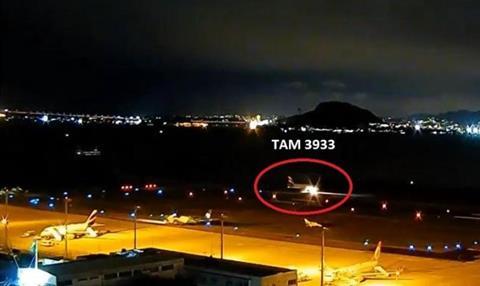
Some 90s after the A319’s take-off clearance, the crew of the Azul E195 was authorised to land on 20L.
Its crew testified that they had only seen one of the two runways illuminated, but that this did not raise any concerns.
Santos Dumont’s runways are closely-spaced, separated by just 33m. The E195 aligned with illuminated runway, the parallel 20R, in error and subsequently landed.
Another LATAM A319 received landing clearance for 20L but its crew told the tower that the runway lights were off, and carried out a go-around, before the lights were switched back on.
The lights had remained off for 7min 17s.
CENIPA says a shutdown command for the runway lighting circuit was recorded just before the lights extinguished.
It has ruled out a system failure, and traced the shutdown command to the air traffic control supervisor’s console.
“Since the controller claimed not to have performed this action, and the system log detected the command, it can be assumed that it was entered unintentionally [either] by the supervisor himself, or another person who may have bumped into the console,” says CENIPA.
It points out that the lighting control system did not issue an alert, and adds that the system’s graphic interface used “confusing” colours – yellow and amber – to represent ‘on’ and ‘off’ respectively, rather than the more intuitive green and red.
CENIPA says there were opportunities to detect the error before the E195’s wrong-runway landing, particularly noting that the tower controller did not visually observe the aircraft at the time of issuing landing clearance, when he might have seen that it was out of alignment with 20L.