














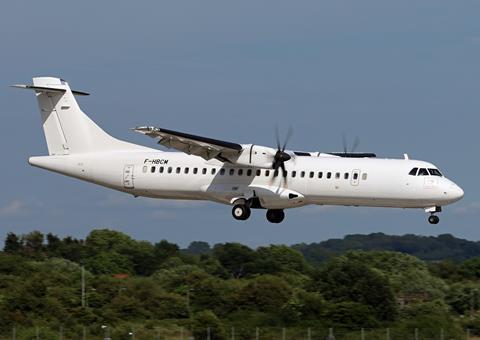
French investigators have disclosed that an ATR 72-500 departed Caen outside of operational limits – and almost outside certification limits – after a data-entry error during load calculations.
The Chalair Aviation aircraft had been conducting a service from Caen Carpiquet airport to Kerry in Ireland on 21 September last year.
As part of the load calculation the ground-handling operations agent unwittingly omitted a minus sign while entering the aircraft’s dry operating index – typing ‘15.5’ rather than the correct ’-15.5’.
The dry operating index is a reference for the centre-of-gravity position at dry operating weight, the total weight of the aircraft excluding fuel and passenger load.
When validating the load sheet the agent had to add the aircraft registration – the turboprop being used (F-HBCM) had replaced the originally-allocated F-HAPL – and this meant the location of passengers on board had to be manually entered.
Owing to the undetected index error, this process resulted in an indication that the balance needed correcting, and two passengers were moved from the eighth seat row to the third.
When the captain signed off the load sheet, he did not notice the incorrect index entry.
Just 13 passengers were on board, and French investigation authority BEA says a cabin crew member thought their distribution – mainly in the forward and central sections – was “unusual”, given the low load factor.
Although he mentioned this to the cabin manager, she assured him that the captain had validated the distribution.
When the aircraft took off from runway 31, however, the captain felt the aircraft was nose-heavy. The control column required “abnormally high effort”, says BEA, and the necessary trim did not match the weight-and-balance figure.
After contacting Chalair’s ground operations manager, suspecting a data-entry error, the captain was instructed – via air traffic control – to move six passengers from the forward cabin to the rear. The aircraft subsequently landed at Kerry without further incident.
Analysis by Chalair indicated that the aircraft’s centre-of-gravity on take-off was 15.9% of mean aerodynamic chord, which is beyond operational limits – although still within the certified weight-and-balance envelope for take-off and landing.
But simulation showed that a small additional deviation in the centre-of-gravity – equivalent to shifting just one or two passengers between the cabin zones – would have been sufficient to exceed the envelope.
BEA says that, with a simple symbol error on the dry operating index, an out-of-balance aircraft scenario is “not unlikely”. It states that Chalair suspended its use of the weight-and-balance software, among other measures, after determining that the possibility of incorrect index entry was a “safety flaw”.