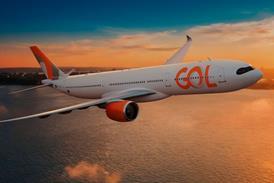












Investigators have disclosed that a Boeing 737 Max pilot’s evasive action at high speed, during a night take-off, averted a head-on impact with a maintenance pick-up truck parked in the centre of the runway.
Accelerating along runway 10 at Rio de Janeiro on 12 February, the Gol Max 8 was travelling at 153kt and approaching rotation when the crew saw the vehicle in the darkness 185m ahead.
Brazilian investigation authority CENIPA says the flying pilot applied a pedal input to initiate an “abrupt” veer to the right just 0.5s before the aircraft collided with the truck.
This action prevented a direct impact with the nose-gear, the inquiry says, “significantly reducing damage to the aircraft and the severity of injuries to those involved”.
While the truck was wrecked, both occupants survived. None of the 103 passengers and six crew members on board the 737 Max was injured.
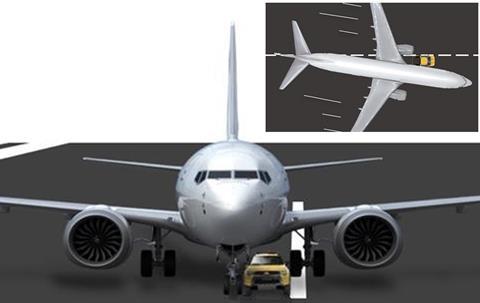
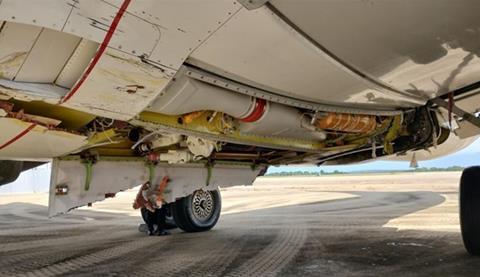
Although the aircraft remained within the runway’s lateral limits during the evasive manoeuvre, it received substantial damage to its underside as its nose-gear and left main landing-gear passed either side of the truck.
The collision damaged hydraulic, fuel and air-conditioning systems as well as the brake lines and flap transmission. Fairings and panels near the wing-fuselage junction also needed replacement or repair.
CENIPA states that the tower supervisor co-ordinated with a tower controller the entry of the vehicle to the runway.
The controller then initiated a screen-locking procedure for the tower’s TATIC air traffic management system, a process which restricted the runway’s use while inspection or maintenance was being carried out.
CENIPA says the truck was parked in the centre of the runway, between taxiways BB and CC, some 2,039m (6,690ft) from the departure threshold. Visibility at the time was good.
After locking the TATIC screen, the inquiry says the controller spent a few minutes “engaged in non-operational conversations” with another individual, before unlocking the TATIC screen “without verifying whether the vehicle had vacated the runway”.
The controller then cleared the 737 Max for take-off, but failed to carry out a visual scan of the runway. Only after issuing the clearance did the controller remember the vehicle, and checked with the tower supervisor whether it had vacated.
“Upon confirming the vehicle’s presence on the runway, [the controller] became alarmed,” says the inquiry.
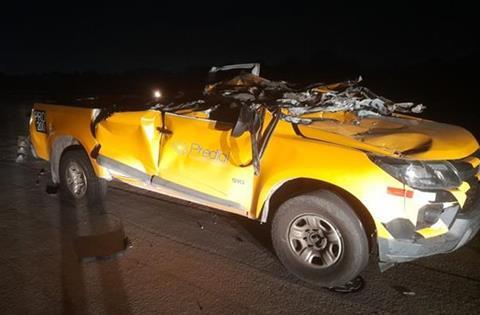
But internal tower video footage shows that, rather than cancelling the take-off immediately, the tower personnel focused instead on attempting to locate the vehicle visually, with a view to removing it without interrupting the jet’s departure.
Controllers interviewed by investigators were unable to explain their decision to manage the situation in such a manner.
But CENIPA believes a low air traffic workload and an “excessively informal atmosphere” in the tower “compromised” their assessment of the risk, and reduced their ability to perceive the severity of the unfolding incursion.
The tower footage revealed several distracting elements including social conversations and use of mobile devices.
“These sources of distraction were decisive in lowering the level of situational awareness in the control room, compromising the continuous monitoring by the [controllers] and leading to a loss of focus on critical operational information,” the inquiry states.