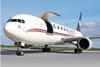












The inflight failure of two auxiliary power unit (APU) doors on a Cargojet Airways Boeing 767 last year likely resulted from a maintenance worker failing to properly secure the doors following a service check.

That is according to the US National Transportation Safety Board (NTSB), which notes that the APU doors, after breaking free from the 767, struck and damaged the jet’s elevator.

The incident involved a Cargojet 767-300ER (registration C-FCJU) operating flight 1926 from Cincinnati-Northern Kentucky International airport to Vancouver on 17 June 2024. Cargojet is a Canadian freight airline.

Cargojet 1

Source: National Transportation Safety Board

The jet’s two APU doors opened and broke free during the flight, damaging the elevators

Following take-off, “while the aircraft was passing through 13,000ft, the flight crew noted an audible ‘loud bang’ followed by airframe vibrations”, the NTSB says in a final incident report released on 20 August.

That sound was apparently produced by the APU doors coming open, separating and striking the elevator.

The jet’s engine indicating and crew alerting system (EICAS) issued the pilots “FIRE/OVERHEAT” and “APU FIRE” notifications.

In response, the pilots levelled the jet at 17,000ft and reduced speed to 280kt (519km/h). Because the vibrations “stabilised”, they began to climb again, then levelled at 24,000ft after the vibrating worsen, the report says.

The pilots returned to Cincinnati and landed without incident.

“The autopilot remained engaged throughout the flight and the aircraft handled normally,” says the report. “Post-flight inspection of the airplane revealed that the APU access doors had separated from the airplane and substantially damaged the lower surface of the left and right elevators.”

Boeing 767s have two APU access doors equipped with four latch assemblies, comprised of latch hooks on the right door and U-bolts and engagement pins on the left.

The doors are intended to be opened by “pushing the trigger in each latch handle using moderate thumb pressure”, says the NTSB.

The agency notes that Cargojet’s records revealed that between 15-17 June the 767’s APU oil level had been checked, which required that the APU doors be opened.

Following the incident, the NTSB examined the left APU access door, which had been recovered. The right door was never found.

For that reason, the agency says it cannot determine the “exact” reason why the doors opened in flight.

However, investigators suspect the doors had not been properly closed following the service check.

“Based on the examination of the [left] access door, it is likely that one or more latches were not fully engaged and closed before departure,” the NTSB says.

Following the incident, Cargojet inspected its entire fleet of 17 757s, three 767-200s and 21 767-300s. The airline found that latch assemblies on three 757s and three 767-300s needed to be adjusted to meet “minimum and maximum closure force limits”, the report adds.