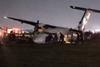













US investigators probing a landing overrun which badly damaged a Falcon 10 have determined that the thrust-reversers did not deploy, because the jet was wrongly configured during approach.
The inquiry into the accident at Northwest Florida Beaches airport, near Panama City, found the checklist in the cockpit was written for an aircraft without thrust-reversers, and only intended for training purposes – with the current approved flight manual taking precedence.
According to the National Transportation Safety Board, the Falcon 10 had been modified with reversers under a supplementary type certificate.
A corresponding supplement to the aircraft’s flight manual contains a pre-flight check which involves activating two ‘emergency stow’ switches, to stow the left- and right-hand reversers, before returning the switches to their normal position.
But prior to the flight from Cobb County airport, near Atlanta, on 6 June 2023 the captain forgot to move the switches back to their normal state.
After a night visual approach, the aircraft touched down about 2,500ft along the 10,000ft runway 16, and the crew deployed the speedbrakes and reduced engine thrust to idle.
But the captain found the thrust-reversers did not deploy, and a warning horn sounded. The inquiry says this horn signalled a system disagreement, because the reverser switches were still in their ‘emergency stow’ position.
While the captain and first officer applied brakes – including the emergency brake – and attempted again to activate reverse thrust, the aircraft did not decelerate.
“The ineffective braking likely occurred because of the engines’ increased thrust output due to the attempted application of the thrust-reversers with the switches in the stowed position,” says the inquiry.
With the captain uncertain over the reversers’ status, he opted against aborting the landing. An attempt to shut down both engines with the throttles was unsuccessful because the reverser handles were still raised.
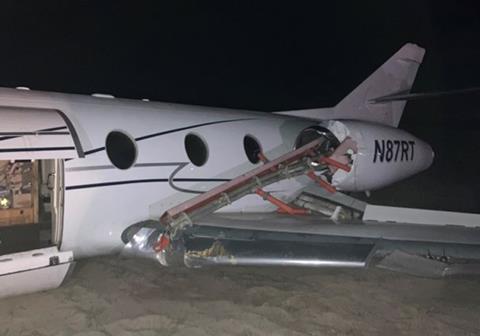
The jet overran and was manoeuvred, using the rudder, between two approach-light support poles with which the wings collided.
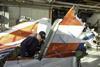
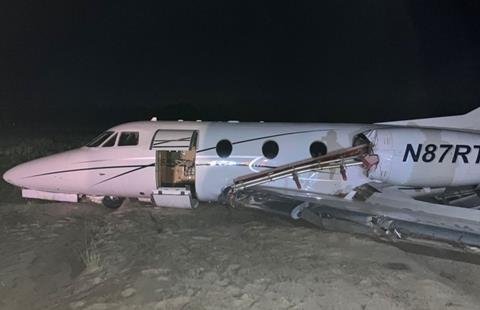
After bouncing over a grassy mound, the jet entered deep sand and came to rest as its landing-gear collapsed. All five occupants – both pilots and three passengers – emerged uninjured, but the aircraft suffered extensive damage to its wings, engines, and undercarriage.
Although the jet was fitted with a cockpit-voice recorder, it contained no information on the flight. The only audio recovered featured communications from when the aircraft (N87RT) was flying under a previous registration (N20CF) – a registration changed in 2017.