














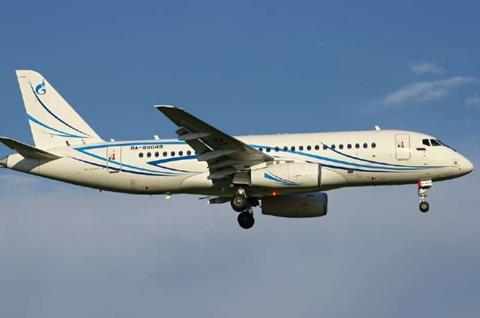
Russian investigators believe the crew of a Yakovlev Superjet 100 thought the aircraft was experiencing an air-data system fault relating to airspeed, rather than a highly-improbable angle-of-attack discrepancy, before the jet fatally dived into a forest about 6min after take-off.
Simulations of the flight have led test pilots to conclude that the Gazpromavia crew – flying from Lukhovitsy to Moscow on 12 July last year – perceived an air-data disagreement warning as indicating unreliable airspeed.
Unknown to the crew, the aircraft’s behaviour was actually due to its angle-of-attack sensors having been wrongly installed during maintenance. Such a scenario was considered so unlikely that the flight manual did not contain a procedure to address it, says the Russian Interstate Aviation Committee.
As the crew attempted to climb, with autopilot and autothrottle engaged and the flaps retracted, the aircraft instead transitioned to a descent as the horizontal stabiliser started countering the apparently-high nose-up attitude, to prevent a stall.
The first officer, who was flying, instinctively pulled on the control column which disengaged the autopilot, before the captain took over and momentarily managed to arrest the descent.
According to the inquiry, the autothrottle was switched off and both pilots remarked that the airspeed was unreliable. Investigators believe the captain, in response to the airspeed uncertainty, increased thrust and tried to increase pitch.
But the disconnection of the autothrottle meant the aircraft accelerated unchecked, exceeding overspeed thresholds. The combination of angle-of-attack protection and overspeed protection meant the aircraft not only responded by entering a dive, but also deployed spoilers which resulted in loss of lift. The situation was unrecoverable.
Simulation using an ‘electronic bird’ test rig in August and October last year indicated that the crew’s interpretation of the unreliable air data as a speed issue, rather than an angle-of-attack error, “predetermined” their actions – including the thrust increase which led to the overspeed.
The simulations also demonstrated that the crew could have brought the aircraft back under control and landed by reducing the engine thrust – the ensure the airspeed remained below the maximum operating threshold – and by switching the flight-control system to direct law.
But the inquiry also carried out simulation experiments, with the participation of 10 pilots from various Russian airlines, to determine the time needed to carry out the procedures for ‘unreliable speed’ indications.
These experiments showed that, from the point that the problem emerged, the time required for crews to perform the tasks and eventually switch the aircraft into direct law was more than seven minutes.
Crews also had “difficulty” in recognising the failure, given that – like the pilots involved in the accident – they were presented with intermittent indications of air-data disagreement, says the inquiry.
“At critical stages of flight, climbing after take-off, the [simulation] crews’ increased psycho-emotional stress was observed, as a result of which the pilots had difficulty finding a procedure in [the quick-reference handbook] and performing it,” it adds.
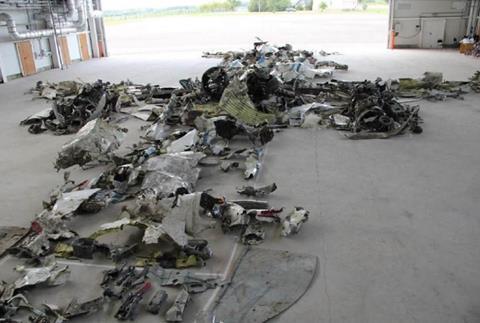
None of the three crew members on board the aircraft (RA-89049) survived after the aircraft crashed near the village of Apraksino.
Investigators state that recommendations for crew actions have since been developed and included in the emergency procedures section of the Superjet 100’s flight manual. The inquiry’s final report into the accident also underlines the need for strict compliance with maintenance procedures when replacing angle-of-attack sensors.