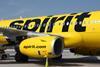
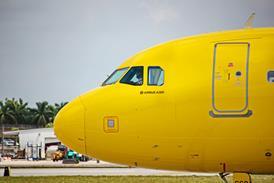












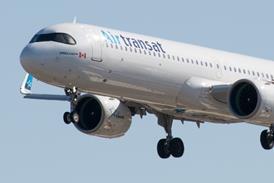
Spirit Airlines is citing problems with the Pratt & Whitney engines that power ultra-low-cost carrier’s (ULCC’s) fleet of Airbus A320neo-family aircraft, as well as the recent termination of leases for dozens of those jets, as major factors in the company’s latest bankruptcy filing.
Chief financial officer Fred Cromer described Florida-based Spirit’s financial situation in a court docket dated 31 August, days after the company disclosed it was filing for bankruptcy for the second time in less than a year.
Factors cited by Spirit include weak demand for low-cost airline seats in the USA, its own less-than-optimal network and intense competition from both fellow discounters and the major US carriers American Airlines, Delta Air Lines, Southwest Airlines and United Airlines.
Cromer also points to the massively disruptive recall of P&W geared turbofan (GTF) engines that has continually grounded hundreds of narrowbody jets since July 2023.
”Optimising Spirit’s fleet is critical and time-sensitive, as manufacturer defects in a type of aircraft engine installed on many Spirit planes has led to a costly and extended grounding of many aircraft,” he says.

Potential GTF engine-blade defects caused by a powdered metal manufacturing issue have prompted P&W to pull hundreds of their latest-generation turbofans off-wing, grounding huge numbers of A320neos, A321neos, A220s and Embraer E-Jet E2s.
A320neo-family operators such as Cebu Pacific, JetBlue Airways, Volaris and Spirit have been among the hardest-hit airlines globally.
”Because Spirit’s fleet relies heavily on the new-generation [GTF] engine, Spirit has suffered disproportionately compared to competitor airlines from various early-stage design and manufacturing issues that have diminished service availability and required accelerated and specialised engine inspections,” Cromer says.
Currently, Spirit has 38 narrowbody Airbus jets grounded for engine work. It anticipates that all 79 GTF engines in its possession will spend time off-wing before P&W’s recall runs its course.
“It could be more than two years before all repairs have been completed,” Cromer says.
Spirit has received compensation packages from P&W amid the engine recall. Most recently, the companies reached a deal expected to deliver $150-$195 million in liquidity to Spirit’s bottom line.
AERCAP LEASE TERMINATIONS
Another major factor forced the airline’s hand on bankruptcy: Irish lessor AerCap unexpectedly terminated lease agreements for 36 Airbus aircraft due to be delivered to Spirit between 2027 and 2028.
Spirit also received a notice of default from AerCap on leases for 37 aircraft in the company’s existing fleet.
“Spirit disagrees that any termination right or event of default existed under any of these leases, and disputes the validity of the notices,” Cromer says.
However, Spirit believed that the default notices could trigger action from other lessors. Potential ramifications for Spirit’s entire fleet convinced company leadership to initiate another bankruptcy process.
”Spirit concluded that it had no choice but to quickly seek the protections of Chapter 11,” Cromer says.
The airline hints that it will pursue potential litigation regarding the validity of AerCap’s default notices and “damages that Spirit has suffered as a result of AerCap’s actions”.
OPERATING DURING RESTRUCTURING
Spirit received US court approval on 3 September to continue business operations as it restructures itself financially.
Parent company Spirit Aviation Holdings says that the US Bankruptcy Court for the Southern District of New York will allow the ULCC to continue selling tickets and honouring loyalty programme points.
Spirit will also keep paying employees and vendors – including vendors that delivered “goods and services prior to the [bankruptcy] filing date”.
Chief executive Dave Davis says the court’s ruling ensures that operations will continue while the airline pursues a transformation “to build a stronger foundation and future for Spirit”.
The airline is engaged with lenders and shareholders “with respect to potential financing that may become necessary” as it completes restructuring.
Spirit emerged from its first Chapter 11 process in March, touting less debt burden and a stronger balance sheet.
But that effort failed to stabilise the ULCC, which posted a $246 million loss in the second quarter and has struggled to find profitability since the beginning of the Covid-19 pandemic in 2020.