








Leonardo is still not naming the partner with whom it plans to establish a “global champion” in aerostructures but aims to have the venture up and running by the end of the year.
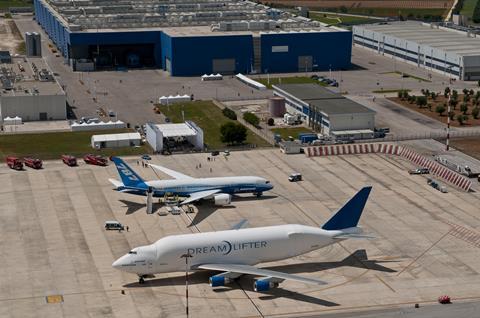
Roberto Cingolani, chief executive of the Italian aerospace and defence group, says the prospective investor in its struggling aerostructures business – earlier named by Bloomberg as a Saudi Arabian sovereign wealth fund – completed “very detailed due diligence” before a 25 July “go/no go” deadline.
The two are now moving into a “second phase” of forming a “partnership plan”. This will include establishing “commercial and industrial synergies” and “engaging with key stakeholders” such as Airbus and Boeing, he says.
Speaking during Leonardo’s half-year investor presentation on 23 July, Cingolani says that while the partnership still must be signed off, both entities are “very much committed… so the probability of success is very high”.
He adds that if the deal falls through, the aerostructures unit – which makes Boeing 787 composite central fuselage sections and is responsible for Leonardo’s 50% share in ATR – will probably reach break-even by 2029 but remain a low-margin operation in a high-tech, profitable company. Bringing in an investor is the “only way to fix permanently the aerostructures business”, he says. “Otherwise, it will never be satisfactory.”
Long-standing problems in the aerostructures business were made worse by the pandemic slow-down and Boeing’s problems.
However, the wider aeronautics division, of which it is part, had a better start to the year, with production of wings and other components for the Lockheed Martin F-35 and Eurofighter Typhoon, as well as 787 fuselage sections and horizontal stabilisers up significantly from the same period last year.
Leonardo attributes a drop in ATR fuselage shipments from 16 in the first half of 2024 to just nine largely to “supply constraints”, and notes that order activity at the joint venture with Airbus is showing “positive signs”.
Revenue from Leonardo’s other divisions – helicopters, space, cyber and defence electronics – was all up for the period, contributing to an overall 11.7% increase to €8.9 billion ($10.2 billion).
Cingolani, who took over as chief executive in 2023, last year began a five-year growth and transformation plan aimed at making Leonardo a €24 billion-revenue business by 2029, a figure he says could be increased by up to €6 billion if Italy, the UK and other European governments fulfill a NATO commitment to raise defence spending to 3% of GDP.
However, he stresses that Leonardo’s expansion will have to be carefully managed to ensure efficiency and cost control. “We don’t want to make another aerostructures situation,” he says, referring to the overcapacity in that business that resulted from growing too quickly in previous decades. “It has to be lean and agile.”
Cingolani says a planned joint venture with Turkish uncrewed air systems (UAS) specialist Baykar Technologies, established in June, is “running fast”, with sales from the new entity expected to start in the first quarter of 2026.
Baykar also completed its takeover of fellow Italian airframer Piaggio in June, and production of UAS platforms for the joint venture will take place at the latter’s Villanova D’Albenga factory, along with Leonardo facilities in Rome and Grottaglie.