














Vertical Aerospace is closing in on the first flight of its third VX4 prototype, with the test asset now in the final stages of reassembly.
Speaking on a 9 July webinar organised by the UK Aerospace Technology Institute – which has funded key aspects of the VX4’s development – chief test pilot Simon Davies said the third aircraft “is in build at Kemble at the moment”.
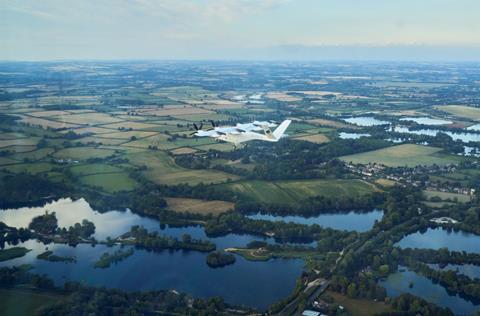
In line with previous examples of the electric vertical take-off and landing (eVTOL) aircraft, initial assembly of the test vehicle took place at partner GKN’s Global Technology Centre in Bristol, before a road transfer to nearby Kemble airfield, Vertical’s test base.
While not disclosing a precise timeline for the first flight, Davies says “we hope to see that out later this year”.
Vertical now has two other pilots capable of flying the VX4 alongside Davies: Tim Eldridge joined in January this year and is supported by ex-Volocopter chief test pilot Paul Stone who arrived in March.
Stone “did his first flight in Aircraft 2 last week”, notes Davies, as the firm ramps up its test activities using the sole remaining test asset, the first prototype having been written off in a 2023 mishap.
Vertical is currently flying the VX4 in a conventional take-off and landing (CTOL) configuration – also known as airplane mode – the third phase of its four-step flight-test plan.
An initial CTOL flight was carried out on late May, followed multiple sorties since, including on 3 July, two on the same day.
Vertical’s next step will be transition flights – moving from VTOL to CTOL mode and back again – which Davies says “we are committing to do this year”.
In addition, Davies says the company has carried out initial “characterisation” of the downwash/outwash from the VX4, although this was “relatively limited” in scope.
The risks from eVTOL downwash/outwash have been in the spotlight since the publication of an initial NASA study in December that found the aircraft capable of generating air flow equivalent to a hurricane-force wind.
Davies says the downwash/outwash flows from the VX4 in hover mode have been considered in its design but “there is more research still to go”.
“A practical experience is that it is quite an easy aircraft to accommodate,” he adds.
Meanwhile, Vertical is hoping to generate sufficient funds to tide the business over until the middle of next year.
Detailing the proposed sale of $60 million-worth of shares – each valued at $5 – Vertical says based on its current plans and cash reserves, the net proceeds should be sufficient “will be sufficient to fund its operations toward the middle of 2026.”
Preliminary management accounts show Vertical had £62 million of cash and cash equivalents on hand as of 30 June.
No timeline for the closing of the share offer is provided. Prior to the announcement, shares were trading above $6 but appear likely to fall sharply in early trading.
Additionally, Vertical has made a trio of executive appointments to bolster its management team: Mark Higson joins as chief operating officer; Steve Vellacott joins as vice-president of airworthiness& head of design organisation; and Eric Samson has been named as vice-president programme-hybrid.