













Boeing has not yet completed work related to an engine anti-ice system redesign it must finish before achieving certification of the 737 Max 7 and Max 10.

That is according to a 24 July Boeing internal employee newsletter that says company engineers are still evaluating design-change options ahead of bringing proposals to the Federal Aviation Administration.

The company has not provided a recent update on the certifications timelines, but comments made by airline customers in recent days suggest certifications and deliveries remain some time off.

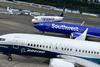
737 Max at Boeing Field in Seattle on 14 June 2022

Source: Jon Hemmerdinger, FlightGlobal

A trio of Boeing 737 Max, including a Max 7 (foreground), at Boeing Field in Seattle in 2022

“Assessing a design challenge like this requires an exacting and diligent effort from our teams,” Boeing programme manager of 737 development Chris Payne said in the 24 July internal Boeing news article. “Not only do we look at the physical components, but we also look at how each design option integrates with the engine, the systems and the airplane overall.”

“What’s next: The team is finalising its analysis of options before further engaging with the FAA,” says the Boeing News Now article.

In January 2024, Boeing said redesigning the type’s engine anti-ice system would take one year. Then in July 2024, Boeing Commercial Airplanes chief executive Stephanie Pope said Boeing had “decided on a design and we will be working through the flight test”.

One-and-a-half years have now passed since Boeing’s one-year estimate and its redesign is ongoing.

“An effective engine anti-ice system requires a complex, integrated design as it touches different airplane systems,” the Boeing article says. “The development team is maturing a technical solution that is one of the last steps to certify the 737-7 and is important to certify the larger 737-10.”

Asked to comment about the redesign, Boeing says, “We are maturing a technical solution that includes design updates… The modifications would be included in the baseline certification of the [Max 7] and [Max 10]”.

Boeing has long said it plans to certificate the 737 Max 7, the smallest variant of the narrowbody family, before completing that of the Max 10, the largest variant.

“We are finalising our analysis and will present the information to the FAA,” Boeing adds. “We will continue to work under their rigorous oversight to meet safety and regulatory requirements.”

Boeing 737 Max 10 at Boeing Field in Seattle on 14 June 2022

Source: Jon Hemmerdinger, FlightGlobal

Boeing has said its 737 Max 10, seen at Boeing Field in 2022, will be the last of the family to be certificated

The manufacturer may provide more information on 29 July, when executives are scheduled to discuss the company’s second-quarter financial results.

FlightGlobal reported in recent days that two US airlines do not expect to receive their first Max 10’s anytime soon.

United Airlines chief financial officer Michael Leskinen said on 17 July that his airline is “hopeful” to start receiving Max 10’s in 2027, but the carrier is making contingency plans in case that does not happen. United holds orders for 167 Max 10s, according to fleet data provider Cirium.

On 24 July, Alaska Air Group chief commercial officer Andrew Harrison said Alaska Airlines will “hopefully” receive its first Max 10s in late 2026 or early 2027.

Also on 24 July, Southwest Airlines CEO Bob Jordan said the airline’s first 737 Max 7 will “maybe” arrive in the first half of 2026. But Jordan hedged, noting he had received no “new” update on the Max 7’s certification.

Alaska holds orders for 56 Max 10s and Southwest has orders for 305 Max 7s, Cirium shows.

Trouble with the 737 Max’s engine anti-ice system came to light in mid-2023 when the FAA ordered operators of in-service models – Max 8s and 9s – to instruct pilots against using the system unless flying in ice conditions or anticipating doing so.

Keeping the engine anti-ice system on more than 5min in dry air could “cause overheating of the engine inlet inner barrel beyond the material design limit, resulting in failure of the engine inlet inner barrel and severe engine inlet cowl damage”, the FAA’s order said.

It added that Boeing was developing a modification and that the problem had caused no known in-flight inner-barrel failures.

But the issue threw a wrench into Boeing’s certification of the Max 7 and Max 10, which were to have the same engine anti-ice system and were, even several years ago, badly delayed.

Boeing soon determined that the engine anti-ice system did not meet airworthiness requirements and would therefore prevent the jets from clearing certification.

The company therefore in November 2023 asked the FAA to exempt the Max 7’s engine nacelle inlet structure and engine anti-ice system, through May 2026, from certification rules related to durability, strength and failures. Boeing said the exemption would not erode safety, calling a failure “extremely improbable.”

If approved, the exemption would have allowed the Max 7 to be certificated and to enter service with the original engine anti-ice system. Boeing had planned in the interim to complete the redesign and to update the in-service fleet (including all Max variants) with the fix.

But Boeing changed course two months later, in January, when it withdrew the exemption request, saying instead it would first complete the redesign and then seek certification.