













Ultra-fast aircraft developer Boom Supersonic has pivoted its strategy to first develop an electricity generating turbine for AI data centres, and then to use revenue from that product to fund development of its conceptual Overture airliner.
The news, revealed on 9 December, marks a major shift for Denver-based Boom, which since coming on the scene in 2014 has doggedly stuck to its vision of re-introducing supersonic air travel.
Boom founder and chief executive Blake Scholl insists that goal remains front and centre, describing the shift toward power generation as providing Boom a clearer and more-concrete means of eventually bringing Overture to market.
“We’re not taking our eye off the airplane. We’re just getting the engine out the door first,” Scholl tells FlightGlobal.
“This is a resequencing and ultimately an accelerant” for Overture, Scholl adds. “This is going to make supersonic flight come back much sooner than it otherwise would have.”
But the Overture project will take a “short-term delay”, with Scholl saying Boom still aims to get the aircraft in customers’ hands within roughly five years.
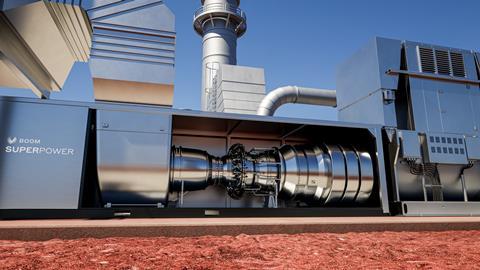
In revealing its new strategy, Boom also said it landed another $300 million from a financing round led by Darsana Capital Partners. Scholl says that money will fund development of Boom’s planned natural-gas burning 42MW electricity generating turbine, called “Superpower”.
AI infrastructure start-up Crusoe, also based in Denver, has ordered 29 Superpower turbines to feed its AI data centres, leaving Boom holding $1.25 billion worth of orders for the engine, it says.
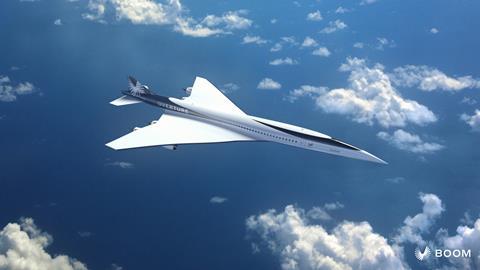
Boom says the plan makes sense because Superpower’s core will be nearly identical to the core Boom has been developing for Symphony, the turbine intended to power Overture. That aircraft is to carry 60-80 passengers and fly at Mach 1.7.
Boom’s shift reflects both opportunities in the AI sector and the challenge of creating an aircraft engine. Several years ago, after major engine makers backed out, Boom set out to develop such an engine largely on its own, with support from Florida Turbine Technologies. Some observers viewed the project as far too expensive and complex for a start-up to navigate.
Indeed, Scholl now says developing Overture’s engine could cost “a few billion dollars” – and even then, Boom would need to prove to customers that the engine is reliable.
Amid that uphill climb, Scholl received two calls: one from OpenAI CEO Sam Altman, among Boom’s initial investors; the other from Cully Cavness, co-founder of AI infrastructure start-up Crusoe.
“They both said, ‘Blake, we need you to re-sequence the product line, to do the power turbine first and the airplane second,’” Scholl says.
The strategy makes “all the sense in the world” and “solves the biggest [Overture] problems”, he adds. “We’re going to… sell these power turbines, and we’ll collect all the reliability data.”
Power turbine sales will then generate all the cash required to fund Overture, Scholl insists, saying the new $300 million is “actually the last investor money we ever need”.
The Superpower turbines are intended to provide power to individual AI data centres. They will compete with power turbines produced by companies like General Electric.
Scholl says Boom’s product will benefit from being based on a clean-sheet turbine, and that it will not, like competing products, suffer performance degradation when operated in hot temperatures.
Boom has already started building the first few Superpower turbines near Denver. It anticipates completing initial test runs next year and delivering the first in 2027.