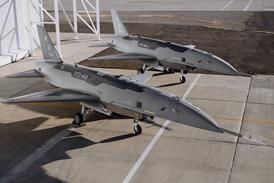











NASA has revealed more detail about the recent first flight of its X-59 Quesst supersonic demonstrator jet, a milestone the agency describes as demonstrating its continued ability to manage large-scale projects that push aerospace technological boundaries.
Additionally, NASA released images and video of the needle-nosed X-59’s maiden 28 October sortie, which had been delayed several times and finally came nine years after Lockheed Martin won the contract to develop the aircraft.

Lockheed on 28 October revealed that X-59 got airborne. But NASA had not immediately acknowledged the accomplishment owing to the then-ongoing US federal government shutdown.
Now, with the government having opened on 12 November, the agency is calling attention to the 67min flight of an aircraft it and Lockheed developed for the purpose of testing design features intended to quiet sonic booms.
NASA has said the programme could help persuade the overturning of the USA’s decades-old ban on overland civilian supersonic flight and possibly herald a new era of supersonic commercial aviation.
“X-59 is the first major, piloted X-plane NASA has built and flown in over 20 years – a unique, purpose-built aircraft,” NASA associate administrator for its Aeronautics Research Mission Directorate Bob Pearce said on 19 November. “This aircraft represents a validation of what NASA Aeronautics exists to do, which is to envision the future of flight and deliver it in ways that serve US aviation and the public.”
On 28 October, NASA test pilot Nils Larson taxied X-59 – a single-pilot jet powered by one 2,000lb-thrust (95kN) GE Aerospace F414-GE-10 engine – from Lockheed’s facility in Palmdale, California to the adjacent US Air Force Plant 42 airport.
Lockheed assembled the jet at the Palmdale site, which is in the California desert northeast of Los Angeles.
“Then, with a deep breath, steady hands and confidence in the labour of the X-59’s team, Larson advanced his throttle, picking up speed and beginning his climb – joining the few who have taken off in an experimental aircraft for the first time,” NASA says.
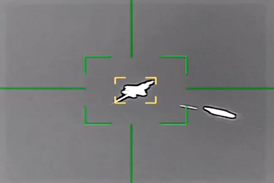
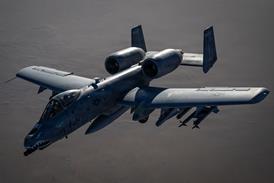
X-59 was flanked during the flight by a NASA Boeing F/A-18 research jet.

The flight “went as planned”, with the jet accelerating to about 200kt (370km/h) and climbing to 12,000ft – “conditions that allowed the team to conduct in-flight system and performance checks”, NASA says. “As is typical for an experimental aircraft’s first flight, landing gear was kept down the entire time while the team focused on ensuring the aircraft’s airworthiness and safety.”
Larson landed at Edwards AFB, about 22 miles (36km) north of Palmdale and home to NASA’s Armstrong Flight Research Center, where X-59 will be based.
First flight complete, the NASA-Lockheed team transitions to preparing X-59 for a “full flight-testing” programme that will involve flight-handling evaluations building to eventually bringing the jet to its “target cruising speed” of Mach 1.4 at 55,000ft, NASA says.

Following an initial flight-testing phase, NASA intends to take ownership of X-59 from Lockheed and then to begin the tests for which X-59 was developed: evaluating its shock-wave-reducing design.
NASA plans to complete a series of “community flights”, measuring the loudness of X-59’s sonic boom and collecting feedback from people on the ground.
“Most X-planes only live in the restricted airspace… This one is going to go out and fly around the country,” says NASA Armstrong centre director Brad Flick.

At supersonic speed, shock waves start at an aircraft’s nose, move aft and come off “all the major elements of the aircraft, all the way to the tail”, NASA aerospace engineer Craig Nickol previously told FlightGlobal.
X-59’s long and slender fuselage helps prevent those waves from “coalescing into a strong shock wave that causes a sonic boom on the ground”, he said.
Engineers also located most X-59 external features atop the aircraft, and gave it a structure under the engine nozzle called an “aft deck” – all to direct shock waves up, not down.
The jet has no forward facing windscreen – another anti-shock-wave measure. So NASA equipped it with an “eXternal Vision System” composed of cameras and a cockpit display, so the pilot can see ahead and below.
NASA has estimated X-59’s sonic boom, measured on the ground, will be quieter than 75 perceived dB – like “distant thunder” or “neighbours shutting a car door”, Nickol has said.
By comparison, Concordes’ boom came in at 105 perceived dB.