













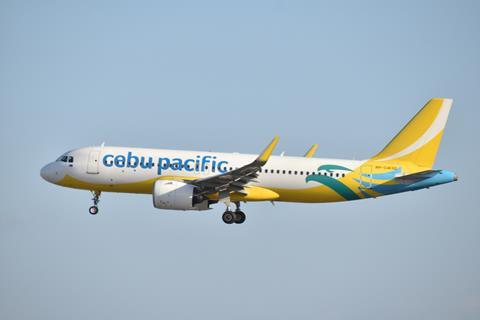
Supply chain snags remain the “single biggest risk” to Cebu Pacific’s growth strategy, as airline executives acknowledge that its ongoing engine reliability issues have “persisted longer than expected”.
Cebu Pacific’s chief financial officer Mark Cezar says the low-cost operator has 12 Pratt & Whitney PW1100G-powered Airbus narrowbodies currently grounded – a figure higher than initially predicted.
Cezar, who was speaking at the airline’s earnings call on 7 August, says a similar number of A320neo-family aircraft will be grounded through end-September, but there will “be some improvements in the fourth quarter in time for the Christmas peak”.
The groundings come as the airline reveals it has received some compensation from P&W, in the form of four spare PW1100G engines, valued at about Ps4.76 billion ($83.6 million) in total, and providing a boost to its quarterly earnings.
Still, airline chief Mike Szucs says the compensation is “nowhere close to the sufferance we have as a result of this [grounding]”.
The airline had to cut back on its capacity growth targets for the year as a result of uncertainty over the engine issues – from between 20-25% capacity growth to around 15%.
“We entered into the year thinking that we would [be able to grow at 20-25%], but then progressively the situation has deteriorated,” Szucs says.
Their comments come as Cebu Pacific reported significant improvement in its earnings. For the three months to 30 June, the airline more than doubled its operating profit to Ps6 billion.
During the quarter — a traditionally-strong period for the airline – Cebu Pacific says it was helped by an uptick in passenger travel demand. Revenue for the period grew by 26%, outpacing a 16% increase in costs.
The airline saw a six-fold rise in its net profit to Ps8.5 billion, as it took into account the engine compensation from P&W.