














Loganair’s growth over the past decade has largely been by filling gaps left by failed, fellow regional carriers. However, the Scottish airline’s chief executive is “very cautious” about opening new services from east of England airports vacated by Eastern Airways, which collapsed in October.
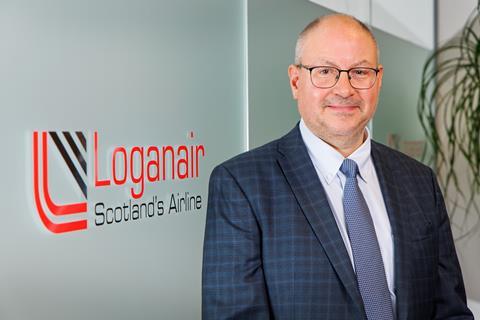
Speaking at the Aviation Club in London on 10 December, Luke Farajallah said one of Humberside-based Eastern Airways’ core demographics – North Sea workers commuting between Aberdeen and east coast cities such as Newcastle, Hull, Norwich, and Teesside – had “seen its heyday” and was “in decline” due to a lack of government appetite for oil field exploration, and that was a reason behind the airline’s demise.
A series of bankruptcies in recent years – from Flybe to the latest, Jersey-based Blue Islands – has left the Scottish carrier as the UK’s only significant regional airline. However, Farajallah says the Glasgow-based private business will continue its “conservative” approach to expansion, which involves rarely competing on a rival’s route and avoiding bank debt.
Despite this, consolidation has created opportunities. After taking on a host of former Flybe routes before the pandemic, the operator did step in to reinstate some Blue Islands services after that carrier collapsed last month, with Farajallah describing the Channel Islands as a “great new market for us”.
The canny approach of Loganair’s main shareholders – brothers Stephen and Peter Bond – extends to its fleet. Although it recently replaced ageing Saabs with newer ATRs, Loganair will continue to operate most of its 11 turn of-the-century-era Embraer ERJ-145s for another five years. However, Farajallah concedes that “we may have to look at some new ATR 72-600s” for the Channel Islands services.
The reticence to acquire aircraft is partly because “the regional market is not exactly full of options”, he says, with ATR the only manufacturer of large turboprops and no 50-seat jets in production, although the likes of Deutsche Aircraft and Heart Aerospace are looking to enter the market.
Farajallah admits that the costs of maintaining older jets coupled with longer downtimes resulting from a “broken post-Covid supply chain” are a challenge, noting that “what used to be a 90-day engine turnaround can now take 200”.
Although Loganair remains profitable, Farajallah, an industry veteran who succeeded Jonathan Hinkles early last year, is worried that rising operating costs and the UK government’s decision to increase air passenger duty could make regional aviation unviable. “My worry is that cost inflation means you reach a price point where it becomes unaffordable for most people,” he says.
One of the most significant steps in Loganair’s evolution has been securing slots at London Heathrow in 2021 as airlines vacated during the pandemic. Today it operates 30 flights a week into the airport from the likes of the Isle of Man, Derry, and Dundee. Its codeshare with British Airways allows it to offer customers access to the flag-carrier’s global network.
Farajallah says he is “interested to see” whether the opening of a third Heathrow runway – which could happen in the mid-2030s – will open more connectivity for regional carriers. However, Loganair is not basing its long-term strategy on the expansion.
“The reality is that we will always have to give way to bigger aircraft and bigger carriers,” he says. “We love Heathrow, but we don’t have to be at Heathrow.”