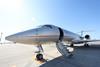













Bombardier has marked the entry into service of the Global 8000, hailing the Mach 0.95 type as the world’s fastest business jet.
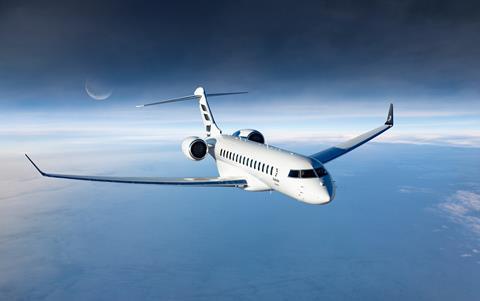
At a ceremony at its Mississauga assembly plant near Toronto on 8 December, Canadian businessman Patrick Dovigi, a Bombardier customer for 15 years, formally took delivery of the first example. The founder of environmental solutions firm GFL will replace his current Global 7500.
Although the GE Passport-powered Global 8000 has been certificated by Transport Canada, it has still to be cleared to fly commercially by US and European regulators, but Bombardier says both approvals are expected in early 2026.
The Global 8000 was launched alongside the Global 7500 (originally the Global 7000) in 2010. However, its development was put on hold as Bombardier focused on the Global 7500, until the airframer announced in 2022 that the 8,000nm (15,000)-range Global 8000 would replace the 7,700-range Global 7500 as its flagship product.
Owners of Global 7500s will be able to upgrade them to the Global 8000 specification via a service bulletin through Bombardier service centres, which the manufacturer says will be available in early 2026 and cost around $3 million.
The Global 8000’s closest competitor is the similarly sized Gulfstream G800, which entered service in August and has a slightly longer range at 8,200nm. Meanwhile, Dassault is developing the 7,500nm-range Falcon 10X.
Bombardier claims the Global 8000 has the lowest cabin altitude of any business aircraft at 2,691ft at 41,000ft.
Describing it as “the ultimate business aircraft” that “exceeds expectation in every way”, Bombardier chief executive Eric Martel says the type “is redefining the business aviation landscape with its innovative design, signature smooth ride, unmatched performance and a promise fulfilled to our customers”.
Since stopping Learjet production in 2021, Bombardier offers five products: the Challenger 3500 and 650, and the Global 5500, 6500 and 7500/8000. During the 2010s it ended its commercial aircraft activities, divesting its CRJ regional jet programme to Mitsubishi Heavy Industries, its Dash 8-400 turboprop to De Havilland Canada, and the CSeries (renamed the A220) to Airbus.
Martel declines to be specific about product plans, stating: “Bombardier has always had a culture of aviation. This is not the end of the journey. We are thinking about what comes next, which could be a derivative product. When the customer demand is there, Bombardier will be part of it.”