











Climb to the fifth floor of Empire Aviation Group’s half-built headquarters overlooking the ramps and runway of Dubai’s Al Maktoum airport (DWC), and through the haze of a September afternoon you can count more than 40 parked business jets. And that is not including the ones out of sight in the hangars of DC Aviation Al Futtaim (DCAF), ExecuJet MRO, Falcon, and Comlux – just some of the business aviation services companies that have opened there in recent years.
The airport, known by its designation DWC (after its original Dubai World Central name), has become the undisputed hub for business aviation – not just in the United Arab Emirates but in the whole of the Middle East. And its success reflects the wider achievement of Dubai in luring high-net-worth individuals from all over the world to the opulent, sunny, tax-free, and investment-friendly emirate.
The Dubai authorities began encouraging business aviation traffic and service providers out of the slot-constrained Dubai International (DXB) and into the new DWC about a decade ago. The trend has intensified in the past two years, with a flurry of infrastructure projects at what is marketed as the Mohammed bin Rashid Aerospace Hub (MBRAH), a cluster of business aviation, light industrial, and training facilities around the airport.
ExecuJet MRO Services and DCAF – a joint venture between German charter provider DC Aviation and the local Al Futtaim group – are among those providing maintenance services for business aviation operators. Meanwhile, there are now no fewer than five fixed-base operations (FBOs), handling VIP traffic coming into and leaving DWC.
DCAF has a standalone FBO, as does Luxaviation’s ExecuJet (for the past five years, a separate business from the Dassault-owned MRO operation). Meanwhile, Jet Aviation, Falcon, and Jetex share a private terminal divided into three. Although not FBOs, Comlux and Empire are among the aircraft management and charter outfits that have built or are opening flagship headquarters at the airport.
Empire’s under-construction premises – directly opposite the shared FBO and due to open around the middle of next year – will include offices that the company plans to rent out, as well as units on the ground floor which founder and managing director Paras Dhamecha hopes will attract upmarket retailers and perhaps even an OEM showroom. He says the original concept was for a more modest set of offices, “but it evolved into this because there was so much demand”.
Dubai’s business aviation sector is booming, according to Dhamecha, because it has become “a safe base for the wealthy” at a time of global turmoil. “If you look at everything from rising taxes in the UK to the geopolitical issues around the world, Dubai can offer security, safety, a quality of life and an ease of doing business. It is attracting a lot of investment and anyone who lives her or does business here and can afford it seems to be buying a private jet,” he says.
Empire’s main business is managing many of those jets. With air operator certificates in the UAE and San Marino, the company – which has a pavilion at the Dubai air show this week – looks after 25 Airbus, Boeing, Bombardier, Embraer and Gulfstream aircraft. It is also an independent sales representative in India for Gulfstream.
Around 10 of its managed aircraft are available for charter, another segment of the market Dhamecha says is “extremely strong” both in the Gulf and beyond, with many who turned to private aviation for the first time during the Covid restrictions and subsequent airline and airport disruption remaining loyal. “We are seeing sustained interest in all our services from individuals and families, corporates, and government entities,” he adds.
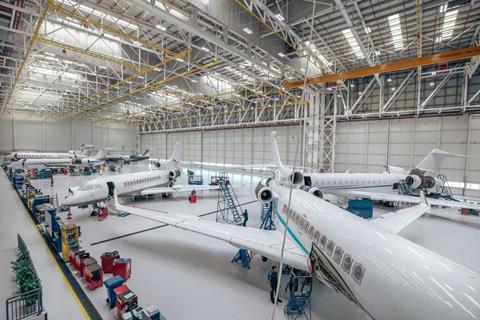
Not far from Empire, one of the biggest developments at DWC is ExecuJet MRO Services’s new hangar, which looks even more impressive as it is joined to the FBO and parking hangar of its former sibling ExecuJet, retained by Luxaviation after the divestment of its global MRO operations to Dassault in 2020. The project was underway before the businesses split, with both facilities opening in 2023.
One of the strengths of ExecuJet MRO Services – which retains a line station at DXB, where the former combined business’s Dubai site was established in 2006 – is that it has approvals across multiple brands, says Nick Weber, regional vice-president of the Middle East. In fact, Bombardier, its original anchor manufacturer and joint venture partner at DXB, remains its “main revenue driver”.
However, the fact Dassault did not previously have MRO representation in this part of the world means ExecuJet MRO in Dubai now looks after 90% of the French OEM’s regional fleet, and a similar proportion for Embraer. “Dassault will make up about 30% of our business this year, but that is from zero in 2020 because we previously never supported Dassault,” says Weber. “A lot of Falcons have come into the region, and we have others from Europe and elsewhere transiting.”
Although Bombardier removed ExecuJet MRO Services’ authorised service status when it was acquired by Dassault, ending its ability to provide warranty work, Weber says a lot of local Bombardier customers have stayed loyal. And even when Bombardier opens its in-house service facility in nearby Abu Dhabi next year, he expects the Bombardier business to remain strong, helped by its authorisation from GE Aerospace to service the long-range Global 7500’s Passport engine.
Another recent arrival at MBRAH is Comlux. The Swiss management and charter company, and completions house, opened its 20,000sq m service and maintenance centre in December last year. It combines a 5,000sq m light maintenance, aircraft cleaning and parking hangar, with regional headquarters, and upmarket showroom, with the first-floor customer lounge containing a cabin section mock-up of the Airbus ACJ TwoTwenty.
Comlux Completion in Indianapolis has the exclusive contact with the European airframer to outfit the first 17 examples of the latest member of the Airbus Corporate Jet family. Comlux, as a European Union Aviation Safety Agency Part 145 maintenance organisation for the type, completed its first ACJ TwoTwenty maintenance check at the facility last year. The Zurich-based firm says the Dubai centre brings it closer to and helps it better support its customers in the region.
Meanwhile, DCAF, which was the original business aviation tenant at DWC after establishing its FBO and maintenance hangar there in 2013, has become the airport’s first operator to join World Fuel’s Air Elite Network, a global grouping of more than 80 independent FBOs who can use the brand in return for meeting certain standards.
For many years, DWC’s perceived middle-of-nowhereness – it was opened in 2010 on what was effectively desert south of the city – appeared to be a turn off for many business jet users, who preferred DWC in the heart of the original downtown. But as Dubai’s business and residential centre of gravity has moved south – with developments such as Dubai Marina and the Palm as well as around the airport itself – DWC seems much better connected to the heartbeat of the city.
For hundreds of operators and their passengers, as well as dozens of service providers, it has become the natural gateway to this truly global city.
Building at Al Bateen
While DWC may be the biggest business aviation hub in the UAE, Abu Dhabi’s Al Bateen is its closest rival. The Abu Dhabi authorities began turning the former military base into the UAE’s only exclusive business aviation airport in 2008, and in recent years it has secured at least two prominent infrastructure developments.
In 2023, Dubai-based Jetex took over and refurbished the main private terminal at the airport. The operator – which has about 45 FBOs around the world – describes the architecturally striking facility as one of its flagship sites.
In April this year, Bombardier announced it was starting work on a service facility at Al Bateen, having in December 2022 said it had broken ground at Abu Dhabi International, its original location for its Middle Eastern maintenance hub.
The 11,000sq m (120,000sq ft) site, which features a 5,000sq m hangar, parts depot and maintenance shops, is due to open in the second half of next year.
Al Bateen began life in the 1960s as Abu Dhabi’s main airport, becoming a military base when the international airport opened in 1982. It is managed by Abu Dhabi Airports (ADAC).