













BAE Systems has demonstrated the performance of its APKWS laser-guided rocket during test firings involving a version of subsidiary Malloy Aeronautics’ T-150 quadcopter uncrewed air system (UAS).
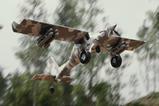
Conducted at the US Army’s Dugway Proving Ground in Utah using a TRV-150 platform, the activity “destroyed both air and ground targets”, the company announced on 17 July.
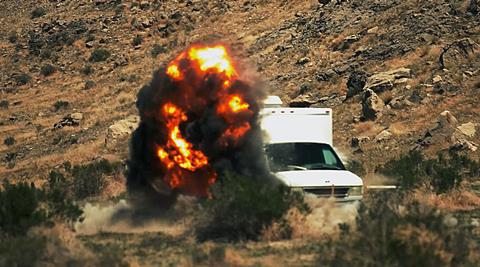
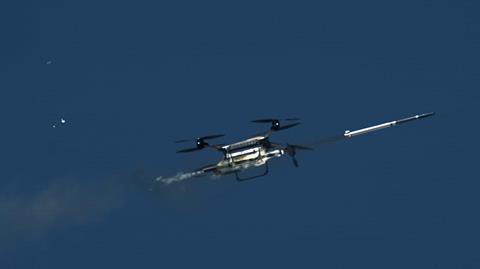
“The tests exceeded expectations in all aspects, including platform performance and target engagements, with zero misses,” it says. The work “marks the first air-to-air engagement of an APKWS guidance kit from a UAS”, the company adds.
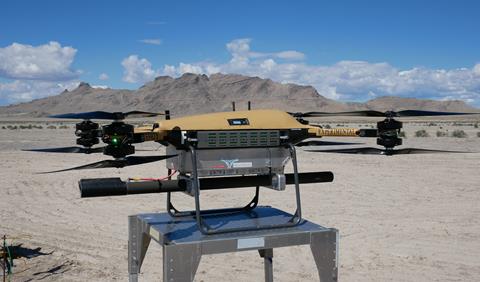
The TRV-150 carried a single, tube-launched APKWS rocket beneath its fuselage during the tests.
“This marks a major step forward in the development of a low-cost strike and counter-UAS option for frontline troops,” BAE says.
“These trials have significantly advanced our ability to deliver this new tactical option at a fraction of the cost of conventional means,” adds Anthony Gregory, business development director at its FalconWorks innovation unit.
The TRV-150 platform was developed in conjunction with partner company Survice Engineering, optimised for addressing a logistics requirement for the US Marine Corps.
“Providing medium UAS-delivered air and ground target strike capability will be a force-multiplying game changer,” says Survice president Greg Thompson of the APKWS addition.
“The team behind this cross-Atlantic partnership will now build on these successful trials to further refine the new system so that it is ready for use on the battlefield. This includes integrating more autonomous technology,” says BAE.
The test activity also involved support from Arnold Defense, General Dynamics UK, Invariant, and L3Harris.