





Beijing displays new Y-9FQ anti-submarine warfare and Y-9LG electronic warfare aircraft alongside unmanned combat systems, while Putin and Kim Jong Un attendance highlights growing security partnerships.

China’s long-anticipated military parade to celebrate the 80th anniversary of the end of the Second World War offered glimpses of possible new aircraft but produced no major surprises.

The parade took place in Beijing’s Tiananmen Square. Chinese ruler Xi Jinping, flanked by the strongmen of North Korea and Russia, Kim Jong Un and Vladimir Putin, observed the event from the Gate of Heavenly Peace. They were joined by representatives of other – mostly authoritarian – nations.

Y-9FQ

Source: Chinese social media

The Y-9FQ. China has worked to boost its anti-submarine warfare capabilities

The flying component of the parade, conducted in smoggy conditions, featured a broad range of helicopters and aircraft, many of which have been observed before, as well two new support aircraft.

Otherwise, the long-rumoured Xian H-20 stealth bomber failed to make an appearance. Also absent was video footage of Shenyang J-15Ts performing EMALS (electromagnetic aircraft launch system) launches from the new CNS Fujian aircraft carrier, although Chinese media has hinted in recent months that this milestone has been achieved.

Despite a lack of interesting new types, the parade featured a huge aerial armada including Changhe WZ-10 attack helicopters, which flew in an ‘80’ formation.

China unmanned helo

Source: Chinese state media

An unmanned helicopter that appears to resemble the US Navy’s MQ-8

The three most recent variants of the Xian H-6 bomber – the J, K, and N – also made an appearance.

Two H-6Ns flew in formation with a Xian Y-20U tanker that had its centreline refuelling hose extended, underlining the bomber’s strategic reach in the nuclear strike role. The type carried CJ-10K cruise missiles under the wings. The JL-1 air-launched ballistic missile – the main armament of the H-6N – appeared on a truck grouped with the parade’s nuclear forces.

Fighters such as the Chengdu J-20 and Shenyang J-15 had a prominent role, as did the new Shenyang J-35 stealth fighter. The J-35 will operate from Chinese aircraft carriers; the J-35A is entering service with the People’s Liberation Army Air Force.

China Parade

Source: Chinese state media

Unmanned combat aircraft – likely mock-ups – appeared in the ground segment of the parade

Support assets, such as the Shaanxi KJ-500 and KJ-600 airborne early warning and control aircraft, also conducted flyovers. In a Chinese TV clip during the parade, the carrier-capable KJ-600’s wings are seen folding into place. Operating from Fujian, the KJ-600 will serve the same role as the US Navy’s (USN’s) Northrop Grumman E-2 Hawkeye, a type it closely resembles.

Two new support aircraft made their debut at the parade: the Shaanxi Y-9FQ anti-submarine warfare aircraft and Y-9LG electronic warfare aircraft.

Both are based on the Y-9 tactical transport. The Y-9FQ is understood to have an active electronically scanned array radar. Online sources suggest it entered service in 2023.

The Y-9LG is designed to supress enemy radars and communications, in a role like that of the L3Harris EA-37B Compass Call entering service with the US Air Force.

The ground element of the display offered a limited glimpse of China’s efforts to develop unmanned combat aircraft.

What appears to be an updated version of the Hongdu GJ-11 Sharp Sword unmanned combat air vehicle (UCAV) was carried by a truck during the event. The GJ-11, which appeared in a 2019 military parade, also borne by a truck, is believed to have entered service. The unofficially designated GJ-21 is understood to be a more advanced version, possibly for use from aircraft carriers.

Ucavs china

Source: Chinese social media

Two smaller UCAVs feature canted tails and dorsal intakes

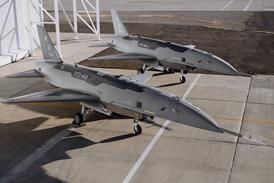
Four distinct single-engined UCAVs also appeared. All four feature low observable radar cross sections.

Two of the aircraft feature dorsal intakes and conventional twin tails. Also featured were two larger tailless UCAVs.

The development status of these aircraft is not clear, and the aircraft displayed at the parade were likely to be mock-ups. Nonetheless, China has conducted extensive work with unmanned aircraft in recent decades.

Also featured were unmanned helicopters, also carried on trucks, that resembles the Northrop MQ-8C Firescout, an unmanned helicopter that the USN is in the process of retiring in favour of smaller, cheaper UAVs. The Chinese system features an electro-optical/infrared turrent under the chin, a housing for a search radar, as well as what could be a side-mounted radar array. 

Frustratingly, parade announcers failed to state designations for the new systems.

Tailless Ucavs china

Source: Chinese social media

The two larger UCAVs lacked vertical stabilisers

Despite a lack of more concrete details about China’s airpower development, the presence of Kim and Putin underlined the growing security partnership between China, North Korea, and Russia.

Chinese and Russian bombers conduct periodic patrols, and Beijing has provided support for Moscow’s invasion of Ukraine, including the surreptitious provision of equipment used in drones and UAVs. North Korea has sent ammunition, arms and soldiers to support Moscow’s war effort.

Given that Russia’s defence aerospace sector has struggled internationally in recent years, recapitalising North Korea’s obsolete air force with more modern types is a clear possibility. Still, this would contravene UN sanctions against the Pyongyang regime.

Beijing, for its part, may be reluctant to openly support Pyongyang’s airpower development, also owing to UN sanctions. Moreover, a better-armed North Korea may be more inclined to start a conflict against South Korea or Japan, something Beijing likely prefers to avoid.

The parade concluded with 80,000 “doves of peace” and 80,000 balloons being released into the overcast sky. The gestures were in sharp contrast to Beijing’s massive rearmament in recent years.