



















Decades after first entering service, the Boeing RC-135V/W Rivet Joint remains a critical electronic intelligence-gathering capability for the USA, the UK and their allies, L3Harris Technologies says.
The US Air Force (USAF) describes the veteran platform’s role as to “support theatre- and national-level consumers with near real-time on-scene intelligence collection, analysis and dissemination capabilities”.
Currently contracted through at least 2035, and with no retirement plan, the joint capability is employed by the USAF and UK Royal Air Force, which has a three-strong fleet of W-model examples.
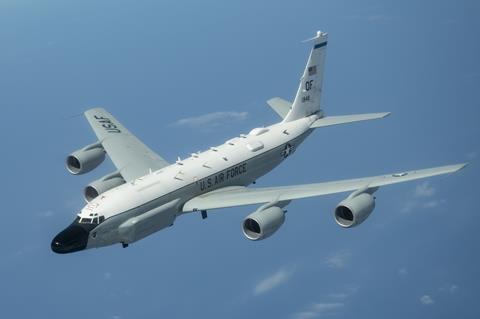
“There are about 30 of these aircraft that are flying today,” L3Harris Integrated Mission Systems president Jon Rambeau says, while noting: “the programme dates back to the 1960s”.
Describing the RC-135 as “perhaps the most sophisticated airborne surveillance and reconnaissance platform in the world”, he notes: “The aircraft gets a full tip-to-tail refresh every four years – that’s the airframe as well as all the technology that resides inside it.”
L3Harris says its primary role is to “detect, identify and geolocate signals throughout the electromagnetic spectrum”.

The UK took delivery of its first RC-135W in late 2013, via an acquisition effort named Airseeker. The US-sourced type replaced its retired British Aerospace Nimrod R1 surveillance aircraft.
Referring to the platform’s continued operational relevance, he says: “The [Lockheed Martin] F-35 wouldn’t be able to conduct the missions that it does without the capability that is provided by the RC-135 – that electronic signals-collection capability to really help the F-35 understand an environment before it flies in it.”
Rambeau spoke to reporters during the 18-20 July Royal International Air Tattoo in the UK, where an RAF Rivet Joint performed a flypast on the opening day and a USAF RC-135V was on view in the static line.

Asked what could eventually replace the current fleet, Rambeau tells FlightGlobal: “The RC-135 is an unmatched capability. While some of the Rivet Joint capability could be integrated on a business jet-size platform, there are some things related to physics and the distance between point a and point b that have to be on a larger aircraft,” he adds, referring to the positioning of equipment such as antennae integrated with the four-engined jet.
Rambeau says L3Harris will ”advance the capability and mission sets for decades to come, as the only partner that can fill this strategic ISR [intelligence, surveillance and reconnaissance] role”.
Story updated on 22 July with corrected details around US-UK contract duration and continued service plan.