











Saab’s internal innovation start-up The Rainforest will fly an unmanned platform next year employing what it describes as “the world’s first software-defined aircraft fuselage”.
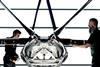
“The fuselage, at over 5m [16ft 4in] long and comprising 26 unique printed parts, will be one of the largest additively manufactured metal structures that will have ever undergone powered flight,” the Swedish airframer says.
The flight-test activity will be performed using The Rainforest-developed Ruby: a GE Aerospace J85-powered vehicle with a 6-7m-span composite wing. Its innovative core structure has been designed and manufactured in partnership with Divergent Technologies.

“The fuselage has successfully passed its structural proof-loading and is scheduled to fly in 2026,” Saab says.
“The fuselage was developed and realised with no unique tooling or fixtures, instead utilising Divergent’s software-defined manufacturing assets that combine industrial-rate laser powder fusion additive manufacturing with universal robotic assembly,” it says.
“With additive manufacturing, load-bearing structures do not have to follow straight lines and right angles as ribs and stringers, but can rather, organically, follow the optimal load-paths,” says Axel Baathe, head of The Rainforest.
Also drawing on artificial intelligence, such design optimisation means “the number of parts in a fuselage can be reduced by at least a factor of 100, replacing traditional riveted machine parts with organic, interwoven structures”, Saab says.

Such a production technique “also enables more flexible weight optimisation and functional integration within fuselage structures, allowing for the printing of wiring, thermal management systems, and hydraulic and liquid systems directly inside the structure”, it adds.
“Software-defined manufacturing brings us the same speed and flexibility that we have during design to our manufacturing,” Baathe says. The goal, he adds, is for design enhancements and changes to be made at the speed of “CAD in the morning, fly in the afternoon”.
“The production factory will be one that reconfigures itself instantly to build whatever our joint digital twin looks like, without being limited by expensive investments in new tooling,” he adds.