














Thales and partner Schiebel are working to arm their Peregrine rotary-wing uncrewed air system (UAS) with the former’s Martlet air-to-surface missiles, as they plot further capability enhancements for their Royal Navy (RN) customer.

Meanwhile, the RN continues to evaluate the intelligence, surveillance and reconnaissance (ISR)-roled Peregrine on deployment aboard HMS Lancaster in the Persian Gulf.

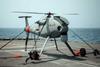
UKMCC-OFFICIAL-Peregrine-c-Crown Copyright

Source: Crown Copyright

Uncrewed asset has been deployed aboard HMS Lancaster in the Persian Gulf

Flown by 700X Naval Air Squadron, the Peregrine was deployed operationally for the first time in February this year on an anti-drug smuggling mission.

The deployment has seen the UAS – comprising a control station and a pair of air vehicles – working in tandem with the Type 23 frigate’s manned Leonardo Helicopters AW159 Wildcat HMA2 rotorcraft to boost the “find, fix and track surveillance function”, says Matt Moore, Thales deputy sales director, ISR UK, speaking at the Royal International Air Tattoo on 18 July.

Based on the Schiebel Camcopter S-100, the Peregrine is equipped with Thales’ I-Master radar, an electro-optical/infrared camera, an automatic identification system receiver, and CarteNav AIMS mission system, enabling the aircraft to perform “deep ISR” missions.

Acquired under an urgent capability requirement (UCR) as part of a broader RN initiative to increase the use of uncrewed air assets – the Maritime Aviation Transformation Strategy (MATX) – the service is working with Thales to boost to the platform’s capabilities, including arming the platform for “enhanced lethality”.

“The concept we are working through at the moment is arming Peregrine with the [Lightweight Multirole Missile] Martlet,” says Moore.

A guided firing campaign is provisionally targeted for 2026 “hopefully in the UK”, he adds.

Moore says the Peregrine will be able to carry a pair of LMMs, but notes that a platform based on the larger, developmental S-300 – offering a 250kg (550lb) payload versus the S-100’s 50kg – could carry up to 10 of the missiles.

To date, interoperability with the Wildcat has consisted of flying off the same helideck, with command and control of the Peregrine handled from HMS Lancaster’s operations room.

Moore says Thales is working initially to understand how to “bring the sensor feed into the Wildcat” – potentially using the company’s Scorpion helmet-mounted display – with a longer-term ambition of allowing the helicopter’s crew to control the sensors or, ultimately, the entire platform, as part of a push towards higher levels of manned-unmanned teaming.

Additionally, the company is investigating the Peregrine’s potential to operate in an anti-submarine warfare role, acting as a relay for signals from a sonobuoy picket deployed by other platforms. A mine countermeasures role is also contemplated through the addition of LIDAR sensors.

HMS Lancaster’s deployment in the Gulf will end later this year when it returns home to be retired.

However, the service is already considering an extension to the two-year contract underpinning the UCR, which kicked off in late 2024. That would likely see the Peregrine deployed aboard another RN ship.

Meanwhile, Moore hails the experience Thales has gained from the programme. “We have learned a great deal about working at pace with a great customer and providing a capability quickly.

“The industry push has been complemented by a [customer] pull,” he says. Key challenges overcome include the difficulties around the logistics and training required given the long-range deployment.

While the RN has yet to launch the procurement of a system like the Peregrine, Moore believes a requirement could emerge later this year as the service accelerates its MATX ambitions.