











The lead prototype of Turkish Aerospace’s (TAI’s) ambitious Kaan fighter remains on track to enter flight testing early next year, as the developer works towards achieving the type’s service introduction later this decade.

“Our goal is to finish the first prototype in the first quarter of next year and to start flight tests,” says TAI chief executive Mehmet Demiroglu. That aircraft will be followed by a second prototype due to get airborne in mid-2026, and then a third following early in 2027.

He notes that in all, six aircraft will support the testing campaign, and that these “will be flying like crazy”, for a total of “thousands of hours”. That activity will lead to the delivery of aircraft to the Turkish air force in an initial Block 10 configuration.

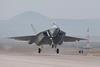
Turkish Aerospace Kaan

Source: Turkish Aerospace

TAI is developing its Kaan fighter for delivery from 2028

“We have promised a very challenging timeline for our air force. We are still shooting for 2028… ish,” he says, with the exact date to be driven by factors also including the airframer’s supply chain – issues there already have seen it slip its schedule for the first prototype’s debut sortie beyond the end of this year.

“That is the challenging part, but we are still maintaining that [delivery] target, so that we don’t relax,” he notes.

Indonesia also recently emerged as a second buyer for the Kaan, with the nation wanting to acquire up to 48 jets.

“I am delighted,” Demiroglu says of Jakarta’s backing. While the exact strength of the commitment had been the subject of some uncertainty, he clarifies: “It is an order. There are some technical requirements that we need to finalise, but from a decision-making point of view it is done.

“The details are basically decided in general – the number of aircraft, technology transfer, the offset requirement – but we are discussing more details and trying to finalise it within a couple of months.”

TAI first flew a demonstrator example of the Kaan in February 2024, having originally planned for that aircraft to be employed only as a ground-test asset.

“What we have done in the past tells [buyers] that they can trust Turkish Aerospace, and the fact that the Turkish air force has already decided to buy this aircraft for their future use tells everybody that they can trust this aircraft as well,” he says. “Whatever you are asking, this will deliver.”

He is also optimistic of signing additional customers. “If not this year, then early next year we will hear something as big as Indonesia… from a nearby country,” he indicates. KAI has previously also promoted the Kaan to Malaysia.

Saudi Arabia is among nations to have expressed interest in the fifth-generation model. He confirms that TAI has been talking to Riyadh “for a long time, and we are still talking”, about products also including the Anka III unmanned air vehicle (UAV), and that he is optimistic of securing it as a future customer.

Meanwhile, he notes that the company is already working to ensure that the Kaan will be able to operate in conjunction with its own Anka III and Baykar’s Kizilelma UAV.

“We are working to make sure that both platforms can work together with Kaan so that different mission requirements can be fulfilled by the time Kaan is delivered to the Turkish air force.”

TAI CEO Mehmet Demiroglu

Source: BillyPix

Chief executive Mehmet Demiroglu also is upbeat about prospects for the Hurjet trainer

Demiroglu is also upbeat about the prospects for TAI’s Hurjet advanced jet trainer, which is in development for the Turkish air force. Spain also plans to field the type, via an arrangement between its developer and Airbus Defence & Space. Pointing to wider market prospects for the single-engined type, he adds: “Why not expand it [the Airbus programme arrangement] to other countries?

“We believe in our aircraft, and I am sure once deliveries have started there will be more to follow. One of our objectives is to make Hurjet a NATO training aircraft,” he says.