














The Federal Aviation Administration has expanded inspection requirements after learning that more CFM International Leap-1As are susceptible to turbine blade cracks and failures due to dust in the air.
A new FAA airworthiness directive (AD) says an issue known already to affect Leap-1As operated in the Middle East also affects those operated in South Asia.
“Further analysis revealed that these same engines are susceptible to similar accelerated deterioration and airfoil distress when operating in the South Asia region,” says the FAA in an order released on 11 December.
CFM, co-owned by GE Aerospace and Safran Aircraft Engines, calls the concern a “known issue” for which it already issued a service bulletin. Customers have been complying with that bulletin for “some time”, CFM says, adding, “We don’t expect operational disruption as a result”.
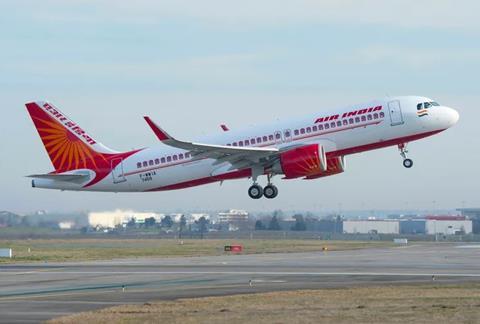
Leap-1As power Airbus A320neo-family jets. The FAA’s order does not apply to Leap-1Bs, which power Boeing’s 737 Max.
The problem became known following two in-flight shutdowns several years ago of Leap-1A’s operated in the Middle East-North Africa region.
The failures resulted from “cracks in the [high-pressure turbine] rotor stage one blades” caused by accelerated “blade deterioration and airfoil distress… due to the build-up of dust”.
CFM addressed the concern in 2022, issuing a service bulletin calling on airlines operating in the Middle East and North Africa to complete borescope inspections of Leap-1A HPT stage one blades. The FAA followed with an AD in 2022 mandating such inspections.
Then in July, CFM issued a similar service bulletin specific to airlines operating Leap-1As in South Asia.
The FAA has now responded again, issuing a final rule that takes effect in 16 days, and doing so without following its usual process of first soliciting industry comments.
The order specifies when airlines must complete initial borescope inspections of HPT blades in Leap-1As operated in South Asia, and requires ongoing inspections at intervals not exceeding either 150 or 300 cycles, depending on the engine.
“The FAA AD is consistent with existing CFM recommendations to operators and reflects our proactive approach to safety management,” CFM says.
No US-registered aircraft are affected, the order says.
Leaps are significantly more fuel efficient than CFM’s prior-generation engine – the CFM56 – thanks partly to burning hotter and at higher pressures. But experts say those factors have caused some Leap internal engine components to fail sooner than predicted, particularly components on engines subjected to the additional stress of operating in dusty environments.
CFM has for several years been working to make Leaps and its other engine models better able to withstand dust.
The engine maker recently rolled out a new Leap-1A durability kit that includes redesigned HPT blades and new high-pressure turbine stage one fuel nozzles and nozzle supports, it has said.
In June, CFM said about one-third of the Leap-1A fleet had the updated configuration.
It is working on a similar upgrade to Leap-1Bs.