














Enhanced hot-section components designed to double time-on-wing for the Rolls-Royce Trent XWB-97 engine in harsh operating conditions are beating expectations during ongoing dust-ingestion testing, the UK propulsion specialist says.
Rolls-Royce has been for several years working to boost the longevity of components in the 97,000lb (431kN)-thrust XWB-97 – the exclusive powerplant on the Airbus A350-1000 – particularly when operated in hot and sandy conditions such as those in the Middle East.
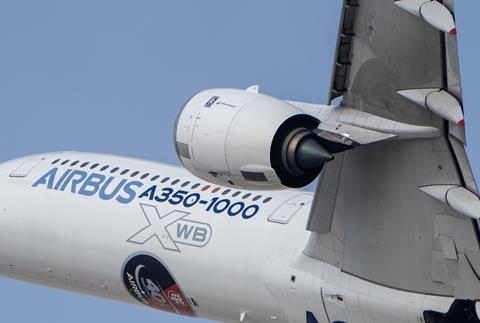
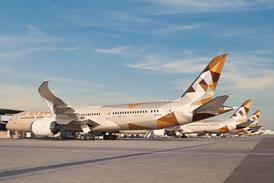
Although Etihad Airways and Qatar Airways, two of the Gulf’s big three, are already customers for the A350-1000, Emirates Airline has declined to acquire the larger variant of Airbus’s big-twin until Rolls-Royce improves the durability of the XWB-97.
Indeed, at the Dubai air show in 2023, Emirates president Sir Tim Clark said he would not consider an A350-1000 order until the engine achieved a minimum of 2,000-2,500 cycles on-wing.
But even prior to Sir Tim’s comments, Rolls-Royce had begun introducing a slate of durability improvements.
Split across three phases, the upgrades, when combined, will double time-on-wing for operations in harsh environments, and by 50% in more benign conditions, up from broad averages of 1,000 and 2,000 cycles, respectively.
While the first two steps are already in operation, a third, more comprehensive set of enhancements is in the latter stages of development, scheduled to enter service in 2028.
Supporting that target, ongoing dust- or sand-ingestion testing of a Trent XWB-97 equipped with the improved components began earlier this year at Rolls-Royce’s Testbed 80 facility at its Derby, UK site, says Phil Curnock, Trent XWB chief engineer.
“That’s what we are doing at the moment. It’s going really well, we have achieved over 1,000 cycles and we are still running.
“The technologies look pretty good, so we are pleased about that; we think it’s a key step forward.”
Results so far are “meeting or exceeding” the company’s expectations, says Curnock: “We are getting more and more confident every day.”
Improvements embodied in the third phase include enhancements to the high-pressure turbine (HPT) blades, such as the modification of internal passages, to increase cooling; the addition of heat-resistant ceramic-matrix composites to the HPT seal; and tweaks to the combustor.
The latter change is designed to “present the very best sort of temperature profile to the blade segment”, says Curnock, reducing potential hotspots “that can focus deterioration in one area”.
But prior to embarking on this latest round of engine runs, Rolls-Royce first had to refine its test process.
Early evaluations were conducted with “relatively big [blade] tip clearance” which “skewed the test”, he says, requiring the manufacturer to learn from and revise the process.
In addition, “we also learned a lot about the amount of sand”, the temperature it was introduced at, and the engine cycle being run.
“We wanted to be really confident that the test, the yardstick… is well-grounded in in-service evidence.”
To ensure the accuracy of the redesigned test, Rolls-Royce “deteriorated a perfectly good new engine” – taking a standard production XWB-97 and subjecting it to over 1,000 cycles of dust-ingestion testing that began in late 2024 and ended mid-year.
It then compared the results to the “hundreds of data points” and “thousands of photos” gathered from overhauled engines that had been operated in the Gulf region, verifying the new test “was absolutely calibrated in that experience”.
Next year, the engine maker will “put that suite of technology fully together” and run another sand-ingestion test, lasting for around four months and amassing “well over 1,000 cycles”.
Flight- and certification testing of the enhanced engine will take place aboard an A350-1000 test aircraft in 2027.
While this will not provide evidence of the powerplant’s improved longevity, it will ascertain “that in creating a really good durability position we haven’t created any other problems”. For instance, changes to the combustor require relight testing to be repeated.
A sixth round of dust-ingestion testing will also be performed in 2027, taking an XWB-97 built to the latest production standard and continuing “to run that engine and establish a fleet leader that says: ‘It all comes together and we are absolutely good to go for ’28’.”
Rolls-Royce has already introduced two previous phases of changes under the durability enhancement programme.
Phase one focused on increasing the temperature margin and improving the turbine case cooling. A second step followed in late 2024, seeing the addition of CMAS attack-resistant coatings on HPT blades and seals.
CMAS attack occurs when the molten residue from ingested dust or sand adheres to component surfaces inside the hot section, severely damaging the thermal barrier coatings designed to protect those parts.
“While it is a little too early to categorically say the outcome, we are positive about it and think it will improve time on wing,” says Curnock.
Although the durability improvement programme is targeted specifically at the XWB-97, he thinks the progress made “stands us in good stead for the future”.