











US aerospace giant RTX has trimmed its 2025 profit forecast due to factors including President Donald Trump’s tariffs, though the company now predicts better than expected sales for the year.
“We continue to see exceptionally strong demand for our products,” RTX chief executive Chris Calio said on 22 July during the company’s second-quarter earnings call.

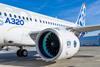
He notes RTX subsidiary Pratt & Whitney (P&W) landed orders last quarter for more than 1,000 PW1000G geared turbofans.
Still, the company has trimmed its 2025 earnings per share forecast by 3%.
RTX now anticipates its Collins Aerospace division will turn a full-year 2025 operating profit of $275-350 million, down from a prior $500-600 million prediction.
Further, the company expects P&W’s 2025 operating profit will come in at $200-275 million, down from a previously expected $325-400 million.
Calio attributes the lower financial forecast to “the expected impact of tariffs”.
On the bright side, RTX hiked expectations for its Raytheon defence business to a $225-300 million 2025 operating profit, up from a prior $150-225 million estimate.
Tariff sting aside, RTX turned a $1.7 billion second-quarter profit, up from a $175 million profit in the same period last year. It reports $21.6 billion in second-quarter sales, a 9% year-on-year bump.
Collins’ second-quarter operating profit increased 5% year on year to $1.2 billion, while P&W’s operating profit slipped 9% in one year to $492 million. The engine maker’s results were affected by a four-week work stoppage caused by an employee strike during the quarter, and by a $100 million charge attributed to a customer’s bankruptcy. RTX does not name that customer.
The Raytheon division earned an $805 operating profit, up more than six times year on year.
RTX has also gotten a better handle on how much tariffs might cost it this year. The result is less than it thought – $500 million, when accounting for offsetting measures, down from a previous estimate of $850 million.
The revision reflects RTX’s own price hikes and Trump pausing some tariffs, Calio says.
Also, RTX is making use of “duty-free exemptions” for military products and identified “opportunities to… qualify more of our imports” as compliant with the US-Mexico-Canada Agreement (USMCA), a trade deal specifying certain products that trade duty free between the countries.
Trump, who negotiated that agreement during his first term, has allowed USMCA-covered products to remain exempt from his new tariffs.
Of the $500 million tariff hit RTX now expects to take this year, it predicts $275 million will fall onto Collins and $225 million onto P&W.