
















Combat aircraft manufacturer Lockheed Martin remains confident in the long-term prospects for its marquee F-35 stealth jet, despite attempts at the Pentagon to reduce US acquisitions.
Although the US Department of Defense only listed funds to purchase a total of 47 multi-variant F-35s in the fiscal year 2026 budget request, Lockheed chief executive James Taiclet says he expects that number will ultimately be raised by congressional lawmakers.
“The House appropriations committee marked up 47 to 69,” Taiclet said during Lockheed’s second quarter earnings call on 22 July.
The armed services committee of the US Senate, which does not have the final say on spending matters, similarly increased the FY2026 acquisition target for F-35s, but only to 57 examples.
“Historically, the appropriations committees have the final say on numbers,” Taiclet says. “I’d be hopeful that the House appropriations committee mark might flow over to the Senate.”
In recent years, Washington has funded the purchase of around 80 F-35s annually, a figure which Lockheed says is necessary to maintain stable production at the company’s primary assembly line in Fort Worth, Texas.
However, the last two years have seen the Pentagon reduce that figure – first to 70 under the Biden Administration in 2025 and now via even more substantial cuts under the Trump Administration.
The stealth jet has attracted scrutiny in Congress during recent years, owing to the multi-service fighter’s long history of cost overruns, schedule delays and lower than expected availability rates.
Lawmakers have become increasingly vocal about their dissatisfaction with the F-35 programme, which is often described as the most expensive defence procurement in history, particularly with lengthy delay in certificating the latest version of the jet, known as Technical Refresh 3 (TR-3).
Taiclet says Lockheed recently completed hardware integration for the TR-3 upgrades and released new operating software to the fleet earlier this month.
“This update improves the pilot interface [and] provides additional weapons and electronic warfare features,” the CEO notes.
In recent weeks, Lockheed also completed delivery of excess F-35s being held in storage. The Pentagon stopped accepting new aircraft for roughly a year while Lockheed worked through issues on TR-3 integration.
US authorities continue to withhold a portion of the payment for each new fighter until the TR-3 issues are fully resolved. The Pentagon’s F-35 Joint Procurement Office expects to turn over the full payment to Lockheed sometime in 2026, as the promised capabilities come online.
Lockheed expects to deliver between 170 and 190 F-35s in 2025, more than the company’s annual production rate of 156 jets, accounting for handover of the stored aircraft.
When it comes to the long-term future of the single-engined stealth fighter, Taiclet says he remains bullish – even if the US does cut its purchases.
“It’s the only fifth-generation fighter aircraft in production right now in the free world and it’s proved itself in combat,” he notes.
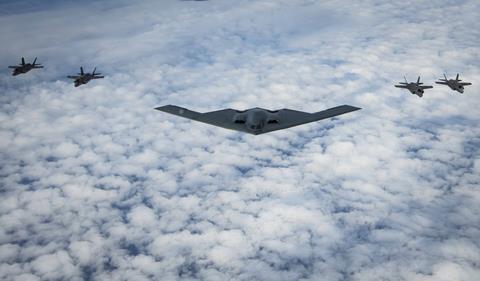
Taiclet says the F-35 was instrumental in the Pentagon’s recent Midnight Hammer operation to strike nuclear facilities in Iran. The stealth fighters were used to clear a path for a flight of Northrop Grumman B-2 bombers, which flew round trip from a base in the continental USA.
Despite a recent rash of concern from US allies in recent months about Washington’s control over F-35 operations and sustainment, Taiclet says international demand for the jet remains strong.
The UK in June said it plans to buy 12 conventional take-off and landing F-35As under its programme of record, with the goal of restoring London’s ability to air drop US B-61 nuclear bombs.
Last week, Belgium expressed its intent to increase its F-35A fleet by 11 examples; expanding its total acquisition to 45 examples.
Taiclet says Denmark is also moving toward expanding its target fleet size.
At the end of June, Lockheed’s F-35 backlog stood at 311 aircraft. The company expects this to increase by at least 150 examples, as it prepares to ink a deal with the Pentagon covering production for aircraft Lots 18 and 19.
That contract is expected to be finalised sometime in the second half of this year.
Even if the USA does cut its F-35 acquisitions, Taiclet says international customers can be moved up in the delivery schedule to maintain the 156-unit annual production rate.
“The demand for aircraft is still going to be there,” Taiclet says. “I’m confident the F-35 production rate will stay strong.”
The former US Air Force (USAF) transport pilot notes that ageing fourth-generation fighters are starting to be retired from service, such Lockheed’s early model F-16As and legacy Boeing F-15C/Ds.
Taiclet assesses aircraft of that generation as “incredibly unsurvivable” in modern air combat conditions.
“A fourth-generation aircraft couldn’t have accomplished that mission that we talked about on Midnight Hammer,” he says, referencing the Iran strikes.
Lockheed will be increasingly reliant on the F-35 for revenue, with the company having been eliminated from sixth-generation development initiatives for both the USAF and US Navy.
Unlike fifth-generation aircraft, European countries are opting to develop their own advanced combat platforms for the sixth-generation cycle. Two separate multi-national efforts aim to bring modern survivable fighters to the continent from 2035.
With that reality in mind, Lockheed is recommitting to an F-35 modernisation initiative announced following its loss to Boeing in the USAF’s Next Generation Air Dominance competition.
“The pivot that we made is… how do we create a best value bridge from today’s fifth-generation to sixth-generation?” Taiclet says.
His goal for Lockheed’s engineers remains achieving 80% effectiveness of a sixth-generation system “both in stealth and other aspects”, at 50% of the cost.
Taiclet describes this “bridge” option as the best value for the US government over the next five-to-10 years, as Boeing works to finalise a design for the new F-47 fighter and start production.
“I’m very, very confident, the F-35 is here to stay, and here to stay in a big way, for a long time,” Taiclet says.