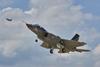
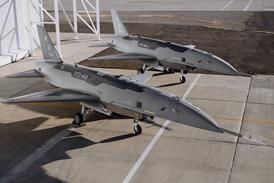














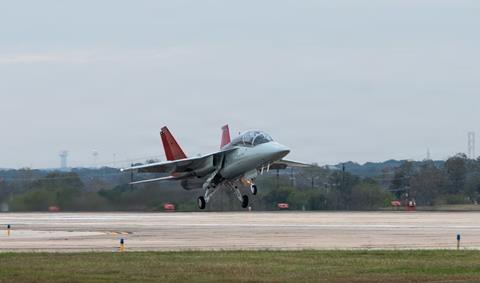
In a major milestone for the training of future fighter pilots, the first Boeing T-7A Red Hawk trainer jet has been delivered to the US Air Force’s (USAF’s) Air Education and Training Command (AETC).
The San Antonio, Texas-based command, which oversees initial flight training for all USAF aviators and crew, received its first T-7A on 5 December.
A T-7A bearing the registration 21-7005 was ferried to Joint Base San Antonio-Randolph from Boeing’s fighter assembly and delivery centre in St. Louis, Missouri.
Boeing’s chief T-7A pilot Steve Schmidt piloted the delivery flight, marking the first Red Hawk example to reach the USAF’s 12th Training Wing that provides new pilot training and instruction on fighter fundamentals.
Schmidt was accompanied by Lieutenant Colonel Phillip Bourquin, operations director of the USAF’s 99th Flying Training Squadron (FTS), who rode in the jet’s rear instructor seat.
“The addition of the T-7A marks the beginning of a new era for developing the air force’s next generation of aviators,” the AETC says.

That new era will see Red Hawks replace the air force’s aged fleet of Northrop T-38C Talon jets, which are used to certify pilots on jet aircraft and basic fighter skills.
The USAF plans to field 351 T-7As, with the new trainer expected to reach initial operational capability in 2027 with 14 jets assigned to the 99th FTS.
Boeing has delivered five production-representative test aircraft to the air force, of which T-7A 21-7005 is the fifth. That aircraft was assembled in 2024, according to fleets data from aviation analytics firm Cirium.
The remaining four jets are assigned to Edwards AFB in California where they are supporting the USAF’s test and evaluation campaign for the T-7A, ahead of its operational fielding.
At the start of 2025, the air force pushed back its planned production decision on the T-7A until 2026 and opted to purchase four additional production-representative test aircraft from Boeing.
Service officials at the time said the move would decrease the gap between assembly of the last test aircraft and the start of rate production, “reducing the likelihood of potential costly retrofits of a significant number of aircraft”.

The T-7A programme is expected to be a significant source of revenue for Boeing’s fighter business, with the USAF planning to purchase 40-60 jets annually by 2033.
The final draft of the annual defence policy bill being considered by the US Congress approves the purchase of 14 T-7As in fiscal year 2026.
Final procurement of the single-engined trainer will take place by 2036.
“The T-38 will remain in service until enough T-7As are in place,” the USAF says.
For the air force, that milestone cannot come soon enough.
The service’s T-38s – it has 486 – are plagued by maintenance issues and obsolescence, with an average age of nearly 60 years old, Cirium data says.
Air force officials have cited availability issues with the T-38 as contributing to delays in training new pilots.
“The T-38 has been life-extended multiple times,” says Brigadier General Matthew Leard, director of plans and programme requirements at AETC.
“There’s an escalating cost of retaining the airplane and keeping it flyable,” he adds. “Additionally, it’s no longer aligned with current or future aircraft.”
The USAF says the 1960s-era T-38 is not up to snuff when it comes to preparing new aviators to operate fifth-generation fighters like Lockheed Martin’s F-35A, or the forthcoming Boeing F-47, which will be the service’s first sixth-generation fighter.
Pilots of those advanced platforms must operate complex sensor systems and transmit targeting data to other battlefield assets – while flying the jets.
Known as information management, those skills will become increasingly critical as the air force develops and fields uncrewed tactical jets, which fifth- and sixth-generation pilots will be expected to manage and direct from the air.
That work poses risk of cognitive overload, which can have fatal consequences.
The air force says the T-7A, with its “all-glass” digital touchscreen cockpit, will shift pilot training away from “traditional seat-of-the-pants flying” toward the “information-driven skills” required to operate fifth- and sixth-generation aircraft.
“From day one, students won’t just be learning to fly, they’ll be learning to manage information, interpret data from advanced sensors and make critical decisions in a complex environment, all from within the trainer,” says Major General Gregory Kreuder, commander of the 19th Air Force.
“The T-7 is more about displaying and ingesting large amounts of information. That really is the challenge of the fifth-gen or sixth-gen world,” adds Leard.
Interestingly, the US Army is seeking to go in the opposite direction with its own flight training programme.
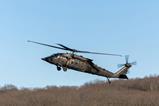
The service is replacing its Airbus Helicopters UH-72As only five years after the H145-derivative was designated the army’s primary rotary-wing trainer.
Senior army leaders blame an uptick in serious rotary-wing accidents on the UH-72’s advanced automation features, arguing that students are not developing essential “stick-and-rudder” skills they need to operate safely in dangerous situations.
Airbus pointedly has disputed that characterisation.
Regardless, the army is seeking to revamp its basic flight training programme with a simpler, single-engined helicopter used for primary instruction.
For now, USAF fighter trainees will continue the existing programme of beginning advanced training on Textron T-6C turboprops before moving to T-38Cs.
A small number of American officers are also undergoing certification at Italy’s International Flight Training School in Sardinia to operate Leonardo’s M-346 trainer.
That aircraft is a contender to be the US Navy’s next jet trainer under a partnership between Textron and Leonardo.
The USAF says its T-7A programme will eventually extend to cover the roles currently filled by both the T-6C and T-38C, with students completing the full fighter fundamentals course on the T-7A.
The 99th TFS is simultaneously developing initial training for Red Hawk pilots and maintainers.
BAE Systems is separately partnering with Boeing and Swedish airframer Saab to offer the T-7A to the UK Royal Air Force, which is seeking a replacement for its BAE Hawk T2 advanced jet trainers and the older T1-model Hawks used by the Red Arrows aerobatic display team.
The T-7A is expected to face competition from Leonardo’s M-346, the Lockheed/Korea Aerospace Industries T-50 and the Turkish Aerospace Hurjet, while UK start-up Aeralis is promoting a clean-sheet modular trainer solution.