












Boeing’s top boss is projecting calm in the face of a potential work stoppage at the company’s fighter aircraft assembly hub.
Workers at several Boeing sites around St Louis, Missouri rejected a contract offer from company management on 27 July, setting the stage for a strike to begin on 4 August if a deal is not reached.
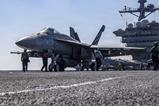
Impacted aircraft include the F-15EX fighter, F/A-18E/F naval fighter, T-7A trainer and MQ-25 unmanned refueller.
The development comes less than a year after a costly and protracted strike at Boeing’s Washington state assembly sites stymied commercial aircraft production for several key jet types.
However, chief executive Kelly Ortberg is downplaying the risk posed by a strike in St Louis, where roughly 3,200 machinists work on Boeing’s various tactical aircraft production lines.
Ortberg notes that that work unit is significantly smaller than the commercial aircraft machinists unit that walked off the job in 2024.
“The order of magnitude of this is much, much less than what we saw last fall,” Ortberg noted during Boeing’s second quarter earnings release on 29 July. “That was roughly 30,000 machinists.”
“We’ll manage through this,” he adds. “I wouldn’t worry too much about the implications of the strike. We’ll manage our way through that.”
The 2024 strike halted production of Boeing’s 767, 777, and 737 airliners for 53 days, costing the company an estimated $5.5 billion.
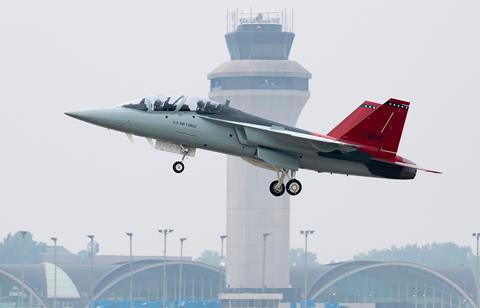
In addition to employing far fewer workers, military aircraft are also delivered at significantly lower volumes than commercial airliners – another factor potentially softening the blow.
Boeing’s defence unit delivered a total of 34 aircraft in the recent second quarter, which includes commercial derivative jets and rotorcraft that would not be affected by a strike in St Louis.
By contrast, Boeing’s 737 deliveries alone reached 42 just for the month of June and 104 across the full quarter.
The International Association of Machinists and Aerospace Workers (IAM) union that represents Boeing employees on the St Louis-area production lines has not said what concerns led members to vote down the contract offer.
“The proposal from Boeing Defense fell short of addressing the priorities and sacrifices of the skilled IAM Union workforce,” the labour group said on 28 July.
Union leaders had endorsed the tentative deal with Boeing management just days before members weighed in.
The head of Boeing’s air dominance unit describes the offer as the richest contract offer “ever presented” to the IAM unit in St Louis.
“We’ve activated our contingency plan and are focused on preparing for a strike,” Dan Gillian said on 28 July. “No talks are scheduled with the union.”
Though the strike could be a stumbling block, Ortberg expresses confidence that Boeing’s defence business would continue on a path to recovering financial stability after years of major losses spurred by poorly-bid contracts and the Covid-19 pandemic.
He also lauds Steve Parker, the now permanent head of Boeing Defense, Space & Security (BDS), who had helmed the troubled unit on an interim basis since September, following the abrupt departure of former BDS chief Ted Colbert.
“Parker is doing a great job in working with his customers to de-risk those programmes and help us get those through the development phase,” Ortberg says.
Senior Boeing leaders, including both Ortberg and Parker, have repeatedly said they see little remedy for turning a profit on money-losing fixed-price contracts like the VC-25B Air Force One replacement.
Instead, BDS is focusing on moving projects like the T-7A trainer and MQ-25 autonomous tanker out of the low-margin development phases and into more lucrative rate production.
Boeing has also significantly changed its bid strategy when it comes to military contracts, eschewing the risky fixed-priced proposals that have cost the company billions by leaving no margin for cost growth or delays.
Ortberg says that strategy includes several recent “big wins”; presumably referring to the secretive F-47 next-generation fighter contract Boeing won in March and a large US Air Force order for up to 84 additional KC-46 tankers announced last week.
“The development parts of those programmes have all been cost-plus, so we’re not making the errors of the past and signing up for fixed-price development, high-risk programmes,” Ortberg reveals.
Without providing a timeline, he also adds that BDS is on track to hitting a previously stated goal of delivering “high single-digit” profit margins.
“[We] see nothing that’s going to keep us from doing that,” Ortberg says.