















With more than 50,000h of operational experience having been accumulated by its uncrewed aerial systems (UAS) over the battleground in Ukraine, Tekever is certainly no stranger to its equipment being flown in challenging conditions.
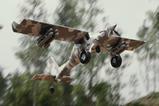
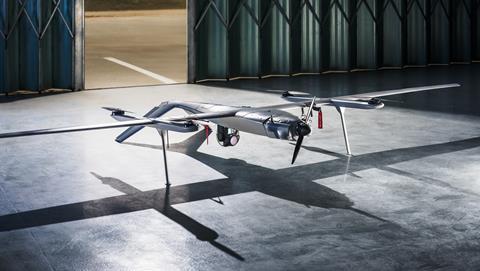
On this occasion, as an example of its new AR3 Evo model rises vertically into the sky in the face of wind gusts approaching 30kt (55km/h) and light drizzling rain, the autonomous drone crabs to maintain stability at an altitude of around 150ft, before transitioning to forward flight over the space of a few hundred metres.
But while the conditions are certainly inhospitable, this is Cymru, not Kyiv: specifically, the remote West Wales Airport site where Tekever is putting the Evo model through its paces during extensive technical evaluations.
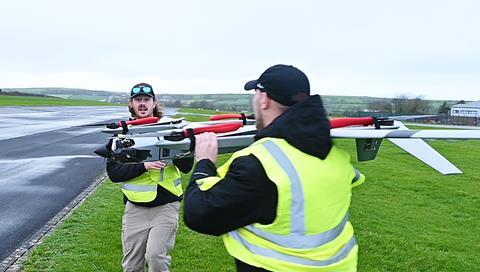
After only moments in the air, the roughly 25kg (55lb) vehicle makes a successful vertical landing before being recovered by ground crew. But in an operational environment, the asset could remain aloft for up to 16h, delivering tactical information gathered by an array of different sensor options.
Unveiled in early September 2025, the Evo is the result of a continual process of product improvements made on Tekever’s baseline AR3, which went through hundreds of design enhancements informed by its combat use. Tasks performed in Ukraine have included “autonomously detecting and tracking vehicles and vessels”, its developer says.
“We did very well in Ukraine [with the AR3], and we built on the back of that,” says Stewart Pearce, the company’s head of training, regulations and assurance, and operational director at West Wales Airport.
“We are fully vertically integrated and deliberately designed for agility at scale,” he says. “That is part of the ethos of Tekever. We want to exploit the agility to develop the best system we can.”
Tekever was established in Portugal in the early 2000s as a software specialist, before starting to produce its own unmanned systems and related equipment around a decade ago. Its AR3 was first deployed by Kyiv’s military in 2022, to “transmit critical intelligence”.

The company’s latest Evo is optimised for persistent intelligence, surveillance and reconnaissance (ISR) tasks, and to be employed in a complex electronic warfare (EW) environment.
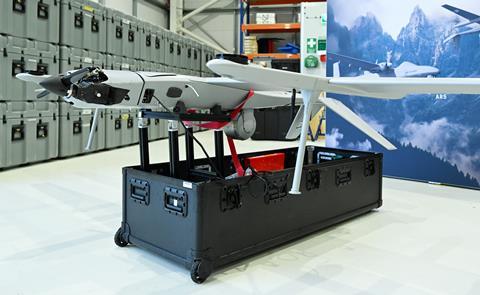
Driven by lessons learned during the attritional conflict in Ukraine, the airframer has established the goal of an operator being able to take the Evo from “box to air” in only 5min, minimising the time that they are exposed to potential attack. That total includes assembly of the vehicle from its transport container.
Launch is performed either by rail – with subsequent recovery by parachute and airbag – or via the use of a vertical take-off and landing kit. To further speed the deployment process, the company is assessing whether the aircraft’s transit box could be modified to provide power directly to the UAS – rather than relying on a portable electric starter – and whether it could launch vertically directly from atop the box structure.
FLEXIBLE OPERATION
The other required operating elements are a lightweight communications antenna and a ground control station (GCS) capability provided by the use of two laptops. That means operations can be overseen with a high degree of flexibility – from a small cabin in the case of the test site in Wales to a mobile team, or even housed within a ubiquitous white van.
As well as being easier to deploy and operate, Tekever has also heaped effort into simplifying the support and maintenance activity linked to the Evo. An engine change, for example, can be swiftly performed by removing only four bolts and two connectors. The UAS can be powered by either an electric or heavy-fuel motor.
And following feedback from operators, the AR3’s previous fuel tank design has been replaced to enable rapid damage repairs: the Evo now carries an easily accessible and rapidly interchangeable 9l fuel bladder, which uses material technology developed for use in Formula 1.
Payload options range from a choice of multiple retractable electro-optical/infrared (EO/IR) sensor designs – produced by Tekever, Hoodtech and Trillium – to a lightweight synthetic aperture radar from supplier IMSAR, and an EW package with electronic attack or jamming functions. Maximum payload is 6kg, spread across two equipment bays.
In early November, the company announced that it had also completed integration work with the AR3 Evo carrying the Warden hyperspectral optical radar provided by Australian company Arkeus.
That payload enables “real-time detection, classification and long-range tracking across maritime, littoral and overland theatres”, Tekever says. That includes the ability for operators “to detect and identify objects that remain hidden, camouflaged or indistinct to traditional EO/IR sensors”, it adds.
The Evo model shares its sibling’s common autopilot and auto-land capability.
RAPID INNOVATION
“Ukraine has demonstrated how fast we can iterate, and how you need to move quickly to keep ahead of the curve,” says Pearce. “Where we beat others is our speed,” he adds.
For use in the combat zone, the AR3 product line has been equipped with a hardened GPS and jam-resistant navigation capability based on the use of stored terrain imagery. With communication options ranging up to carrying a Starlink terminal, the lightweight type has passed back ISR information from a range of 124nm (230km).
For increased operational flexibility, Pearce says: “We have looked at a ground launch and handover to a remote GCS.” The system’s related ground array can also be remotely connected via fibreoptic cable, to distance it from a launch team.
Meanwhile, an updated GCS capability is intended to enable the company to provide full training for a new operator in only five days.
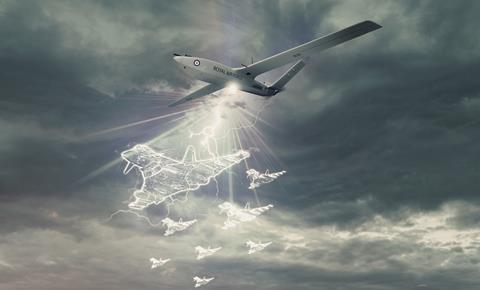
Notably, the company’s baseline AR3 (in its Mk8.8 guise) forms the basis for the StormShroud stand-in jammer fielded by the UK Royal Air Force. The service in May 2025 revealed an acquisition programme for 24 air vehicles equipped with Leonardo’s BriteStorm EW technology, with a “minimum deployable capability” having been declared a month earlier by its 216 Sqn.
Supporting such programmes led Tekever to in 2023 take on the lease for its current unit at West Wales Airport, which features direct access to the single paved runway. Its footprint at the site includes design and engineering, payload integration and testing, plus manufacturing of the AR3 and Evo.
Current output takes around three weeks to produce a complete bonded and painted airframe, with payload integration adding a further week before a test flight is performed.
But as part of a broader investment strategy, the company in July 2025 announced that it had purchased West Wales Airport outright. Previously branded as the Welsh Assembly-backed ParcAberporth centre for UAS testing, which formally opened its doors in mid-2004, the site is now set for a major revival.
“This is going to be a UAS centre of test and evaluation excellence,” Pearce told FlightGlobal during a late-November visit, while adding: “We have got grand plans.”
As outlined at the time of the site’s acquisition, those include expanding infrastructure for it to become “a national hub for the testing and evaluation of unmanned systems, made accessible to UK government stakeholders, allied partners and industry collaborators”.
Today, other tenants at the site include UAVE and Thales, the latter of which continues to work in support of the British Army’s Watchkeeper tactical UAS programme. That system is currently slated to leave operational use in 2027, having been deemed obsolete due to the pace of enhancements driven by the war in Ukraine.
The site provides access to 2,500 square miles (almost 6,500sq km) of “restricted airspace over land and sea”. Including the over-water Cardigan Bay and Llanbedr ranges and mostly used by UAS including Watchkeeper, that airspace is owned by the Ministry of Defence (MoD) and managed by Qinetiq.
With significantly more flight activity anticipated, Pearce says Tekever already has “engaged with the CAA [UK Civil Aviation Authority] to open [additional] future airspace”.
The company also is striving to establish itself as a key employment and economic partner in the area. “We are talking to the [Welsh] government, and to local colleges and universities, trying to shape what courses they run to then feed in local people to work at West Wales Airport,” he says. “We want to be at the heart of the community in this area and open up careers.
“We have to partner and drive the ecosystem to remain resilient,” he notes. “We need to have lots of collaboration – it’s not just about us.”
OVERMATCH INVESTMENT
Thanks to the company’s Project Overmatch activity announced in May 2025, Tekever will invest £400 million ($533 million) and add 1,000 jobs in the UK over a five-year period. The company’s global workforce recently topped 1,000 employees.
Tekever chief executive Ricardo Mendes at the time described the major commitment as “a plan to position the UK to lead the transformation of Europe’s defence landscape by delivering faster, more adaptive capabilities that stay ahead of evolving threats”.
The Overmatch strategy’s four pillars of “build, network, scale and partner” will see it massively increase its footprint and workforce in the UK, Pearce notes.
In addition to adding manufacturing capacity at the West Wales Airport site, the company is in the process of establishing a major new production facility in Swindon, Wiltshire.
Announced in September, the move will deliver the company’s fourth and largest UK production site, to be operational later this year.
The company says that step will support “efforts to bring scaled manufacturing of current and future platforms to the country, ensuring an increasingly efficient and resilient supply chain”.
The 23,600sq m (254,000sq ft) Spectrum Building will host “all elements of Tekever’s production lifecycle, from rapid prototyping to the development of new platform concepts”, it adds. The facility was recently opened for refurbishment work ahead of future manufacturing of the AR3, new Evo and – for the first time in the UK – the company’s larger AR5 platform.
UAS validation flights and pilot training will be conducted at a facility in nearby Wroughton.
And in early 2026 Tekever also will open a new headquarters in Bristol, relocating from a site in Bath to be closer to the MoD’s main procurement hub.
The UK government is already familiar with the capabilities of the company’s twin-engined AR5, with the medium-altitude, long-endurance model being employed in support of the Home Office to monitor illegal migration across the English Channel.
With a maximum take-off weight of 180kg and payload capacity of 50kg, the twin-engined AR5 is flown from Lydd airport in Kent, with baseline AR3s also employed from Dover in support of the service contract.
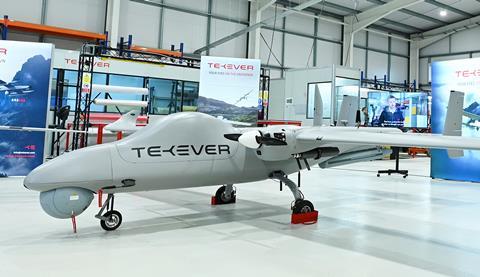
Operations for the Home Office started in 2019, with activities also spanning fisheries protection and pipeline security.
The AR5 was also recently contracted to deliver services to the European Maritime Safety Agency (EMSA) under an initially two-year deal worth €30 million ($35 million). Under the deal – which also includes options to extend the provision by another four years – Tekever will provide two systems, each using a pair of the UAS, “to support simultaneous, multi-region deployments across European waters”.
The aircraft configuration selected for EMSA use will enable a mission endurance of up to 12h, the company says.
Flight testing of the AR5 also is being conducted from the West Wales Airport site, ahead of its production launch in Swindon.
Now more than 20 years since ParcAberporth was opened with a bold hope of becoming a UAS centre of excellence for the UK, the location at last looks poised to deliver on its promise under Tekever’s ownership.