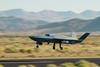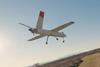
















Uncrewed air vehicle (UAV) manufacturer Tekever has unveiled the AR3 Evo, an all-new variant of its 25kg (55lb) maximum take-off weight platform that features more than 100 improvements over its predecessor, all derived from extensive operational experience in Ukraine.
Launched at the DSEI show in London on 9 September, upgrades on the Evo include a 2kg payload increase to 6kg, endurance that rises to 22h in fixed-wing configuration, and a fully modular architecture that allows for a rapid change to battery power or a vertical take-off and landing (VTOL) configuration.
Additionally, the rear of the AR3 Evo has been reshaped, switching the V-tail to an inverted-V configuration to improve efficiency and payload survivability.
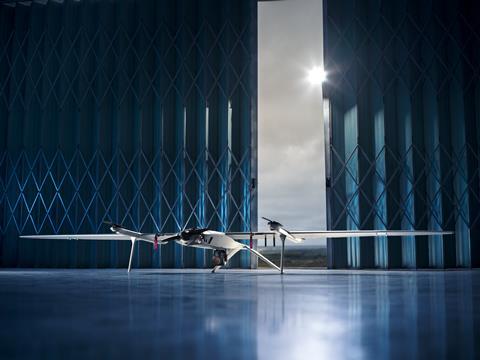
Tekever has been supplying, in collaboration with the UK Ministry of Defence, the original AR3 to the Ukrainian armed forces since the start of the war in 2022 where it has logged over 10,000 operational flight hours.
But, says Karl Brew, director of the company’s defence unit, after 18 months of continual spiral development and iteration to counter constantly evolving Russian air defence and electronic warfare capabilities, it became apparent “that we had to tell the product team to reset”.
“One year in Ukraine is like five years in normal development cycles,” he tells FlightGlobal.
The amount of flying a single platform accumulates in a short period of time, plus the data collected “is hard to underestimate”, he notes.
As part of the Evo development process, Tekever looked to the “rapid advancements in the last three years” across multiple sectors including motorsport, software, automotive and aerospace “so the product is truly tuned to what the customer needs”.
For example, to enhance platform endurance, a fuel bladder was sourced from Formula 1 racing, while the combustion engine was tweaked to give 15% better fuel efficiency.
Consequently, endurance now sits at 22h in the fixed-wing configuration and 14h in VTOL mode.
Around 4kg of mass has also been stripped out of the structure by the use of advanced manufacturing techniques, says Brew, allowing the 50% increase in payload and consequently a greater choice of sensors.
Meanwhile, the switch to the inverted-V-tail offers several benefits: aerodynamic efficiency is improved, payload protection increases during ballistic parachute recovery, and the lower tips of the V serve as the rear landing legs in VTOL mode.
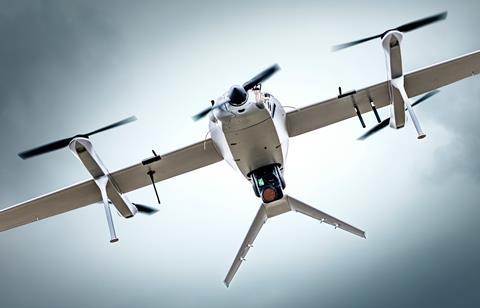
Four different gimbaled electro-optical/infrared cameras have so far been integrated, alongside IMSAR’s NSP-3 synthetic aperture radar.
A “small volume” of initial AR3 Evos have already been shipped to Ukrainian forces, he says, allowing early evaluation of the platform in combat.
But Tekever is already seeing “strong interest” from other potential customers, notably for the maritime variant of the Evo, he says. Configured for VTOL operations, the aircraft is capable of landing on a 5x5m (16x16ft) deck.
Meanwhile, Tekever will next week announce the location for its new manufacturing site in the UK, part of its £400 million ($532 million) Overmatch investment.
No details of the location have so far been disclosed; Tekever says the facility will be along the M4 corridor – a motorway linking London with Bristol in the west of the country – with the Wiltshire town of Swindon hotly tipped as the chosen site.
Brew says the goal is for the “first [Evo] production run” to be built at the new UK factory.
Once established it will add to Tekever’s growing footprint in the country, alongside its recent acquisition of West Wales airport in Aberporth.
The AR3 has previously been selected by the UK Royal Air Force as the air vehicle element of its StormShroud autonomous collaborative platform that is equipped with Leonardo UK’s BriteStorm stand-in jammer technology.