











Kratos and Taiwan’s National Chung-Shan Institute of Science and Technology (NCSIST) have unveiled a new attack unmanned air vehicle (UAV), as AeroVironment (AV) pledges to help Taiwan with autonomous capabilities.
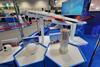
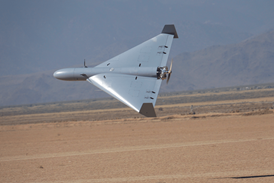
The Mighty Hornet 4 is derived from the MQM-178 target drone and was unveiled at this week’s Taipei Aerospace & Defense Technology Exhibition, according to Kratos.

“The Mighty Hornet 4 marks a significant leap in military capability for Taiwan and a natural extension of the aerial target support Kratos has provided Taiwan for the last 15 years,” says Steve Fendley, who heads the unmanned systems division of Kratos.
“This groundbreaking collaboration truly highlights Kratos’ commitment to innovation and excellence in the defence sector.”
The company adds that the MQM-178 can fly at Mach 0.8 and can perform high-g manoeuvres, with a service ceiling of greater than 35,000ft. An NCSIST video says that the Might Hornet 4 can serve in the surveillance mission, and also carry one warhead under each wing. Targets can include ships and helicopters.
A video rendered by NCSIST shows that the Mighty Hornet 4 is part of a family of locally produced strike drones. The UAVs approach an enemy aircraft carrier strike force, identify targets, and through sheer weight of numbers overwhelm shipborne defences.
Also shown are other Taiwan strike UAVs, the Mighty Hornet 2, dozens of which are shown launching from the back of a truck, and the Mighty Hornet 3, which takes off vertically.
The Mighty Hornet 1, a small loitering munition, is show launching from unmanned surface vehicles and the Albatross UAV, a type in service with Taiwan’s military. The video shows a test flight of a Mighty Hornet 1 striking a bullseye on a floating buoy.

Kratos did not offer a timeframe for the Mighty Hornet 4’s deployment, or say if it has secured customers. The agreement with NCSIST will also see Kratos market the Mighty Hornet 4 internationally.
Separately, AV has entered into a memorandum of understanding with NCSIST to collaborate on autonomous systems in support of Taiwan’s defence needs.
The agreement covers AV unmanned systems such as the Jump 20 and Jump 20-X that are already in service with the country’s military.
“This partnership underscores AV’s long-term commitment to supporting the defence needs of Taiwan and our allies in the Indo-Pacific region,” says AV’s international business development vice-president Justin McFarlin.
“By combining the combat-proven effectiveness of AV systems with NCSIST’s advanced research and development capabilities, we are ensuring Taiwan can produce and sustain mission-critical systems, strengthen deterrence, and respond quickly to evolving threats.”
AV adds that the agreement is part of an offset agreement related to Taiwan’s acquisition of its Switchblade 300 loitering munition.
Taipei sees large numbers of unmanned systems as an effective way to defend against neighbouring China’s superiority in conventional military capabilities.