




















Latin American airline company Abra Group is considering potentially adding shorter-haul jets to better connect markets within Central and South America.
The parent of Colombia’s Avianca, Brazil’s Gol and Spanish wet-lease operator Wamos sees opportunities to boost regional connectivity throughout Latin America. But Abra Group has yet to signal a preference between the Airbus A220 and Embraer 195-E2.
Francisco Raddatz, senior vice-president of fleet and procurement for Abra Group, told FlightGlobal last month that the company that the company is “very interested” in adding more short-haul capacity across its network.
“I’m not saying we’re going to buy regional jets,” he says. ”With respect to narrowbodies, we already have a large orderbook with Boeing and Airbus.” He adds that Abra Group holds the “largest orderbook of new technology planes” among Latin American airlines.
Abra Group said in October it is picking up options for an additional 50 Airbus A320neos, bringing its unfilled order book to about 135 of the narrowbody jets. It also signed a lease with Avolon Aviation to lease up to seven A330neos – on top of last year’s memorandum of understanding with Airbus to take four A350-900s.
Those deals figure to significantly boost the long- and medium-haul fleets of Avianca, Gol and Wamos – and potentially SKY Airline, which could join Abra Group as a member carrier in coming weeks. Combined, those carriers boast an operational fleet of more than 300 jets.
Gol also holds orders for some 75 737 Max 8s and Max 10s, according to fleets data provided by aviation analytics firm Cirium.
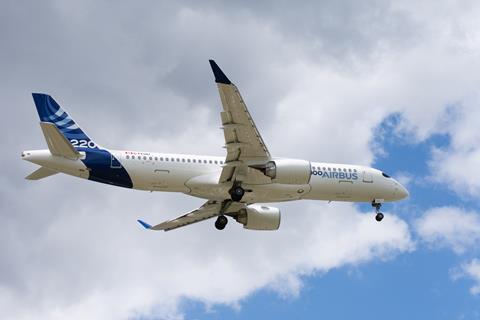
But a gap remains on the smaller narrowbody side of the spectrum. Both the A220 and E195-E2 seat more passengers than regional jets, but have less capacity than A320-family and 737-family aircraft. Both types could help Abra Group connect secondary markets and lesser-used airports throughout Latin America.
Though progress has been slow, both the A220 and E195-E2 are starting to gain traction with Latin American carriers. Argentinian low-cost carrier Flybondi recently revealed plans to order 15 A220-300s and 10 737 Max 10s, with options for another five of each model. Flybondi claims it will become the first A220 operator in Latin America.
Azul has operated a sizeable fleet of E195-E2s for several years, while state-owned carrier Mexicana took its first delivery of the type in June.
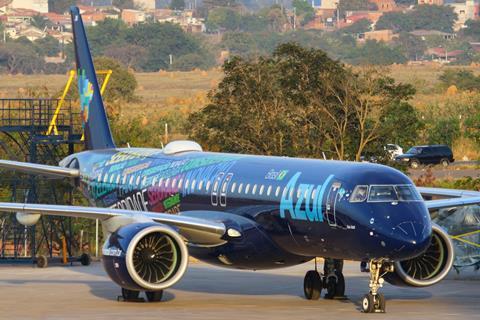
For Abra Group’s part, no deals are imminent, and any potential order of smaller narrowbody jets would depend on timing, market conditions and availability of factory slots with airframers, Raddatz says. Those conversations are ongoing, and he maintains that company deliberations are not influenced by LATAM Airlines Group’s order for up to 74 E195-E2s, or Azul’s fleet of the type.
”We believe there is eventually a market for regional jets not only in Brazil; we’re talking about Central America and Colombia,” he says. “It is not necessarily a correlation of buying regional jets to follow or compete with what LATAM or Azul is doing. This is a full analysis that we’re doing as a group.”
Airbus, for its part, is bullish on potential A220 sales in Latin America – a market skewed heavily toward large narrowbody jets.
Damien Sternchuss, vice-president and head of airline marketing at Airbus Latin America and Caribbean, told reporters in Toulouse last month that it is “only a question of when” the type will catch on with South American carriers.
”We see huge potential for that product,” he says. “Why is the A220 not yet flying in the region? I would say first, the domestic market is extremely strong in our region and [airlines] have been consolidating around the A320 family.”
In recent years, Latin American carriers have upgauged to larger aircraft to make greater use of limited slots at congested airports. But outside of major metropolitan areas, South America has hundreds of mid-sized cities with little or no air service.
”The A220 is capable of operating secondary markets, and it has the range of an A320,” Sternchuss says. ”The aircraft is capable not only of developing additional regional markets… it can also boost intra-regional connectivity.
”This aircraft has the capability of flying 7h, 8h nonstop, so you could easily connect Brazil to the Caribbean, for example.”