












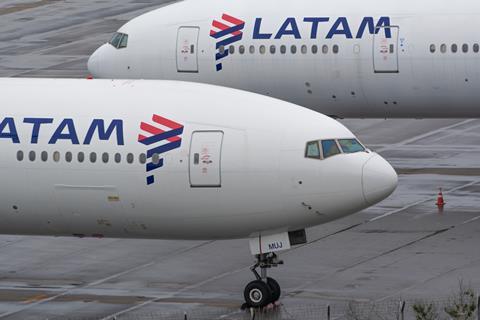
LATAM Airlines is considering how to eventually replace its fleet of Boeing 777-300ERs, acknowledging that the yet-to-be-certificated 777X family and the Airbus A350-1000 are of interest.
But that decision is still years away, chief executive Roberto Alvo said during Latin American airline trade group ALTA’s annual meeting in Lima last month.
“We have 10 777-300ERs, and they’re still relatively new aircraft but at some point in time we’ll have to replace them,” he says.
LATAM is a major Boeing widebody customer with 37 787 Dreamliners in operation and more on order, while it maintains a sizeable fleet of A320-family narrowbody jets.
“Probably, the 787 is too small for replacing the -300ER,” Alvo says. “We will see the 777X. We will see the A350-1000. They are possibilities.”
Alvo emphasises that replacing the airline group’s 777s is not a short-term concern, and he does not signal a preference between the 777-9 and A350-1000.
“Either one of those aircraft will become potentially an aircraft that we’ll operate, but I guess that [decision] goes into next decade,” he says.
Fleets data from aviation analytics company Cirium shows that all 10 of LATAM”s 777-300ERs are stationed with its Brazilian affiliate, and range from 12 to 17 years old.
The first deliveries of the long-delayed 777-9 are now expected to begin in 2027, Boeing revealed last month. The latest delay is a significant setback relative to Boeing’s prior plan to certify the next-generation widebody jet with the Federal Aviation Administration next year.
Meanwhile, Airbus recently rolled out the first ultra-long-range A350-1000 for Australian carrier Qantas’ Project Sunrise initiative.
Alvo says LATAM has been pleased with the increasing stability apparent from Boeing’s 787 Dreamliner assembly plant in Charleston. It expects to take one 787 toward the end of 2025 and another early next year.
“On top of that, we still have 17 more arriving on order, and five options going forward,” Alvo says. “We’re very happy with Dreamliner. The 787-9 is a great aircraft.”
However, he acknowledges it will be difficult for Boeing to return to its pre-pandemic rate of 14 Dreamliners rolling off its Charleston line monthly. (Boeing is currently maintaining production of seven 787s monthly and aims to hit eight monthly by year-end.)
“We’re following that closely, but it looks like a much more focused organisation, and in that sense we’re very happy,” Alvo says. “It was important to get Boeing back on its feet and we’re seeing that.”