












Norwegian investigators believe an unspecified maintenance issue was the likely cause of an in-flight engine failure on a Sikorsky S-92 heavy-twin shortly after take-off from an oil platform.
Having departed from the Linus mobile drilling platform, the Bristow Norway-operated S-92 (LN-OMI) – with two pilots and 14 passengers on board – had climbed to 3,000-4,000ft when the crew heard a “loud bang”, the Norwegian Safety Investigation Authority (NSIA) states in its final report into the 5 June 2023 incident.
Instruments indicated the left-hand engine had stopped and troubleshooting revealed it could not be restarted.
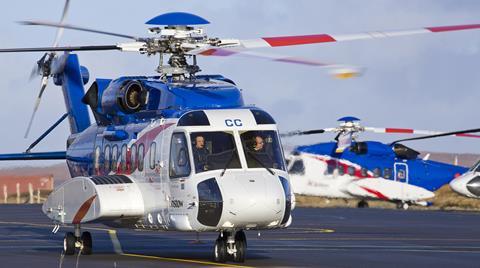
In the event, the pilots opted to complete their mission to Stavanger Sola airport on a single engine – having rejected a return to the platform as unsafe – being met along the route by a rescue helicopter.
Subsequent examination of the GE Aerospace CT7-8A turboshaft showed the joint between its centrifugal impeller and the compressor rotor rear shaft – an interference fit secured by 12 T-head bolts and nuts – had disconnected.
All 12 T-bolts had fractured due to fatigue and caused the uncommanded in flight shutdown, the report states.
Further laboratory analysis by Qinetiq in the UK was unable to identify a root cause for the failure of all 12 bolts, although signs of fatigue were found on each.
“The metallurgical examination could not determine whether the T-bolts had been installed correctly or whether the correct torque had been applied when the bolts were installed,” the NSIA adds.
No other incidents of this nature on a CT7-8A engine were recorded in GE’s database, it says.
Repair of the engine had been carried out by ITP Aero at its facility in Albacete in 2020, finally being released to service in June 2022 and installed in the incident aircraft in November that year, accumulating another 894 flight hours before the failure.
“The NSIA finds it unlikely that the incident occurred because of a material defect in the T-bolts,” it says.
Although certain minor discrepancies were found in ITP’s maintenance procedures, the NSIA was unable to find a definitive root cause for the bolt failures, instead offering a selection of possible scenarios.
“It may be that the tightening torque when installing the T-bolts [was not] within the specified values on one or more T-bolts.
“It may have started at the location where the balance weights were installed with too low or too high a torque. It may also be that the joint of the two components has inadvertently not been matched correctly when installed,” says the report.
Additionally, it notes that ITP Aero has since implemented “safety-enhancing measures on their own initiative”, addressing the agency’s concerns.
Pointing out that the “assembly of the centrifugal compressor and the rear shaft is a critical and complex task” which “increases the risk of human error”, the NSIA recommends that GE improve its workshop manual with clearer wording and additional steps.